Skip to content
Nation / Famous Italians / Science / Galileo Galilei
Galileo Galilei

Galileo Galilei

Published:

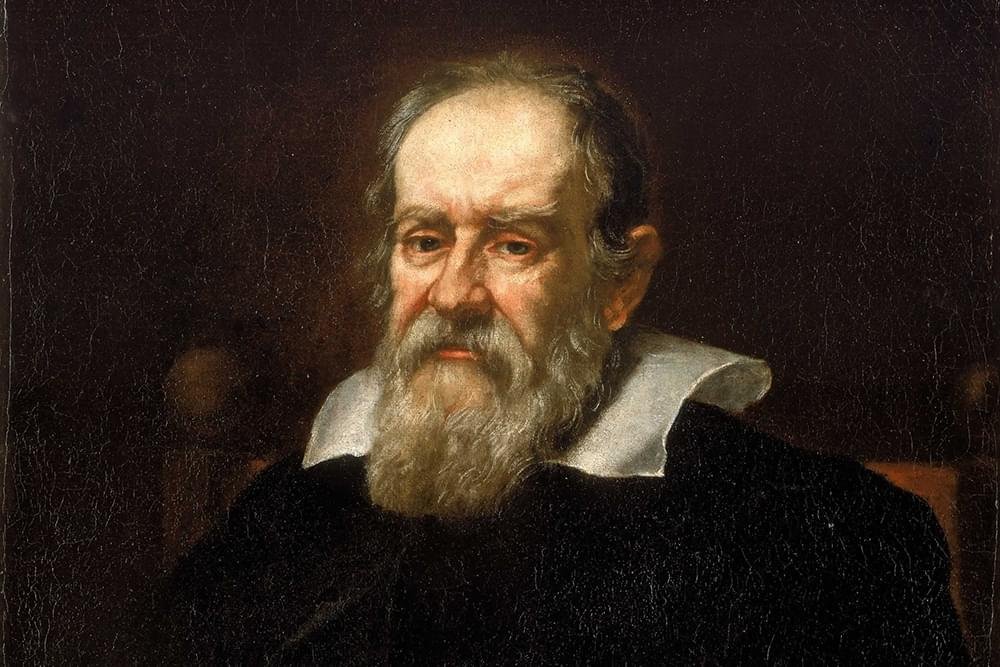
Galileo Galilei was born on 15th February, 1564, in Pisa, Tuscany. He was the oldest of six, possibly seven, children. His father, Vincenzo Galilei, was a famous musician and composer. His mother's name was Giulia degli Ammannati. Although not wealthy, the family were from the Italian nobility.

Although he remained unmarried, Galileo had a relationship with a woman called Marina Gamba and together they had three children. Their two illegitimate daughters, Virginia and Livia, were both forced to enter a convent while their son was eventually legitimised as Galileo's legal heir.

A devout catholic, Galileo originally intended to become a priest but his father encouraged him to enter the University of Pisa and study for a medical degree instead. He soon discovered a preference for mathematics and launched a career as a physicist, mathematician, astronomer, and philosopher that would see him become one of the most influential scientists in history.

Galileo is recognised for his work with telescopes, compasses, pendulums and clocks. He is also recognised for developing a number of important theories which have led him to be called the "Father of Modern Science".

In his book, 'On Motion', Galileo famously contradicted Aristole's assertion that "heavier objects fall faster through a medium than lighter ones" asserting instead that "all objects, regardless of their density, fall at the same rate in a vacuum". Legend has it that he tested his theory by dropping two cannonballs from the top of the Leaning Tower of Pisa.

He also developed 'the basic principle of relativity' which provided the framework for Newton's 'Laws of motion' and Einstein's 'Special theory of relativity'.

However, it was for his investigations in the 'Laws of the Universe' that he is probably best known.

In the 16th and 17th centuries, the Roman Catholic Church followed the doctrines of Aristotle, that the Earth was the centre of the universe and that all heavenly bodies revolved around the Earth. Galileo's various studies and experiements led to him being drawn to the Copernican theory that the earth and planets revolved around the sun, ideas that led him into direct conflict with the Church.

In 1616, Galileo was called before the Roman Inquisition on charges of heresy. He tried to defend his theories on the grounds that the ideas did not contradict the scriptures. The Church did not accept his justification and he was forced to retract his statements and refrain from working on his theories any further.

In 1623 Cardinal Maffeo Barberini became Pope Urban VIII. He was a supporter of Galileo and he persuaded him to publish his ideas in a book entitled 'Dialogue Concerning the Two Chief World Systems'. However, the Pope's support had been conditional on Galileo presenting a balanced view of the conflicting arguments, and including the Pope's own views. He broke the first condition by unashamedly promoting Copernican Theory, and he included the Pope's ideas in such a way as to make him appear foolish. The Pope was not amused and withdrew his support.

The subsequent trial resulted in Galileo being forced to recant his beliefs and being sentenced to house arrest, where he remained for the rest of his life. It also banned the publication of any of his past, present or future works.

It was while under house arrest that Galileo wrote a book called 'Two New Sciences', based on work he had done forty years previously. The book, published in Holland to avoid the Roman Catholic censor, is one of his most influential works and has led him being called the "father of modern physics".

He died at the age 77 on 8 January 1642. Because of his condemnation for heresy, he was initially buried in a small room in the Basilica of Santa Croce in Florence. In 1737, he was moved to the main building and a monument was erected in his honour.

Nation Dossier

Flag of Italy

Italy

A compact nation-state reference: scale, structure, capability, and performance — designed to sit beneath articles.

Governance Economy Made in Italy Performance
Italy — national feature image
Italy at a glance — then the bigger picture: what shaped the state, how it works, what it produces, and where it stands.

Italy — global snapshot

Stable reference signals for quick orientation.

Area

301,340 km²

Covers a long peninsula extending into the Mediterranean, plus two major islands — Sicily and Sardinia — and numerous smaller island groups. The geography includes alpine regions, fertile plains, volcanic zones, and extensive coastline, shaping settlement, climate, and transport patterns.

Population

~59 million

One of the largest populations in the European Union, with density concentrated in urban and northern regions. Long-term demographic trends include low birth rates, population ageing, and increasing reliance on inward migration for workforce balance.

Coastline

~7,600 km

A predominantly maritime nation bordered by the Tyrrhenian, Adriatic, Ionian, and Ligurian seas. The extended coastline supports ports, tourism, fisheries, naval infrastructure, and a long-standing seafaring and trading tradition.

UNESCO sites

61

The highest number of UNESCO World Heritage Sites globally, spanning ancient cities, archaeological landscapes, historic centres, and cultural routes. This reflects Italy’s layered civilisations and the density of preserved cultural assets across its territory.

Currency

Euro (EUR)

Member of the Eurozone, with monetary policy set at European Central Bank level. Use of the euro facilitates trade, investment, and financial integration across the EU single market.

Time

CET / CEST

Operates on Central European Time, with daylight saving applied seasonally. The time zone aligns Italy with major European capitals, supporting coordination in business, transport, and broadcasting.

Tourism

~50–65M

Among the world’s most visited countries, attracting visitors for heritage cities, landscapes, cuisine, and lifestyle. Tourism is economically significant but regionally uneven, with strong seasonal concentration in major destinations.

Global role

G7

A founding member of the European Union and a permanent participant in G7 coordination. Italy’s influence is exercised through diplomacy, industrial capability, cultural reach, and multilateral institutions.

Governance

A layered republic

A parliamentary republic with powers and delivery spread across state, regions, and comuni — which is why outcomes can vary by territory.

Economy

Diversified, export-capable

Services dominate overall output, while manufacturing remains a defining strength through specialised clusters and global supply chains.

Made in Italy

Quality as an ecosystem

Design, craft, engineering, and brand power — often delivered by small and mid-sized firms rooted in local capability.

Performance

Strengths with constraints

World-class sectors alongside long-running challenges: uneven productivity, demographic pressure, administrative complexity, and fiscal limits.

Italy governance
Governance
Italy economy
Economy
Made in Italy
Made in Italy
Italy performance
Performance
Italy history

History

From unification to a modern republic

Modern Italy is a relatively young nation-state built from older city-states, kingdoms, and strong regional identities. Unification created the national framework, but local character remained powerful — shaping language, administration, and culture across the peninsula. The post-war republic rebuilt institutions, expanded democratic participation, and redefined the state’s relationship with citizens through welfare, education, and public infrastructure. European integration then anchored Italy within shared rules and markets, while the late 20th and 21st centuries have focused on balancing growth, reform, and cohesion in a complex, decentralised country.

Italy contribution and influence

Contribution

Europe, culture, industry

Italy’s contribution travels through EU participation, diplomacy, research networks, industrial capability, and cultural reach. In practice, influence is often most visible through specific strengths: design and heritage leadership, advanced manufacturing and specialist supply chains, food and agricultural standards, and world-class tourism and creative industries. Italy also plays a sustained role in Mediterranean and European stability through alliances, humanitarian operations, and institutional cooperation. Rather than a single narrative, Italy’s global presence is best understood as a portfolio of high-impact domains where craft, identity, and technical competence combine.