Skip to content
Nation / Famous Italians / Presidents / Oscar Luigi Scalfaro
Oscar Luigi Scalfaro

Oscar Luigi Scalfaro

Published:

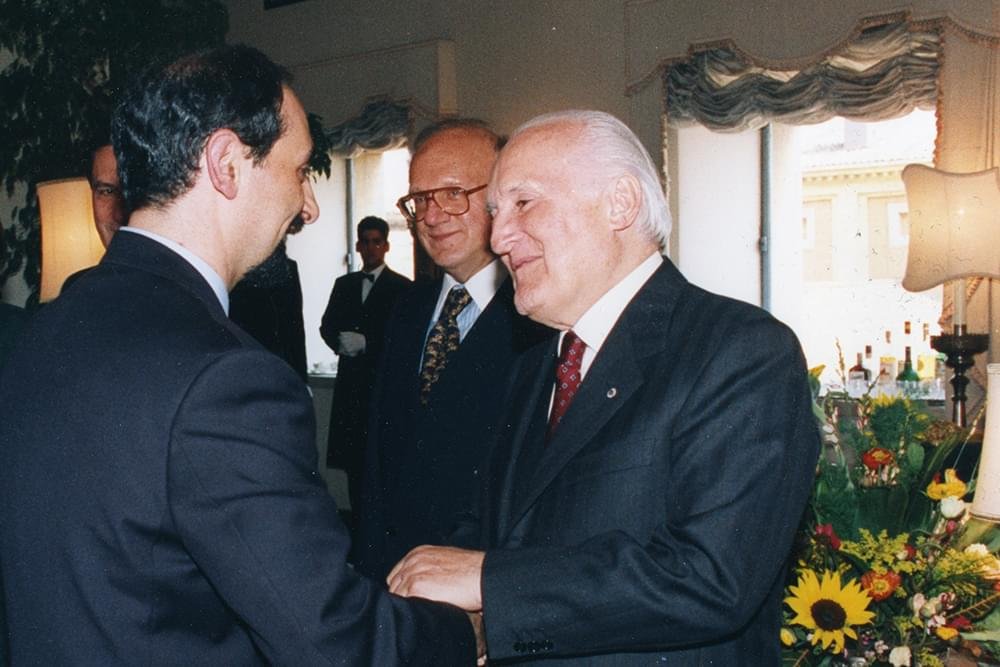
Oscar Luigi Scalfaro, the ninth President of the Italian Republic, was born in Novara, Piedmont on 9th September 1918. He graduated in law from the Catholic University of the Sacred Heart in Milan in 1941 and subsequently entered the legal profession. After the war, he became a public prosecutor gaining the dubious honour of being the last prosecutor in Italy to obtain the death sentence when a court convicted six defendents on trial for collaboration with the Germans.

He entered politics in 1948 when Italy became a republic. He represented Turin for 44 years until his election as President in 1992. Two days after his election, a mafia bomb killed magistrate Giovanni Falcone, his wife and bodyguards. This set the scene for his presidency which presided over some of the most turbulent episodes in Italian political history spanning the transition between the First Republic and the Second Republic.

After his 7 year tenure he became a lifetime member of the Senate. Later, following the 2006 general election, he took over the temporary presidency of the chamber of Deputies and became one of only three politicians in Italian history to have held all three highest offices in the Republic: President of the Republic, President of the Senate, and President of the Chamber of Deputies. The other two are Sandro Pertini and Enrico De Nicola.

Although a lifetime Christian Democrat, he opposed the policies of Silvio Berlusconi's Forza Italia party and supported the centre-left coalitions that won elections in 1996 and 2006.

He married in 1943, but a year later his wife died in childbirth at the age of 20. Scalfaro vowed to never marry again, instead devoting himself to the upbringing of his daughter, Marianna. She too never married, and remained by his side until his death on 29th January 2012.

Giorgio Napolitano, the current President of the Republic said of him "He was a protagonist of democratic political life over the decades of republican Italy, a paragon of ideal coherence and moral integrity..."

Nation Dossier

Flag of Italy

Italy

A compact nation-state reference: scale, structure, capability, and performance — designed to sit beneath articles.

Governance Economy Made in Italy Performance
Italy — national feature image
Italy at a glance — then the bigger picture: what shaped the state, how it works, what it produces, and where it stands.

Italy — global snapshot

Stable reference signals for quick orientation.

Area

301,340 km²

Covers a long peninsula extending into the Mediterranean, plus two major islands — Sicily and Sardinia — and numerous smaller island groups. The geography includes alpine regions, fertile plains, volcanic zones, and extensive coastline, shaping settlement, climate, and transport patterns.

Population

~59 million

One of the largest populations in the European Union, with density concentrated in urban and northern regions. Long-term demographic trends include low birth rates, population ageing, and increasing reliance on inward migration for workforce balance.

Coastline

~7,600 km

A predominantly maritime nation bordered by the Tyrrhenian, Adriatic, Ionian, and Ligurian seas. The extended coastline supports ports, tourism, fisheries, naval infrastructure, and a long-standing seafaring and trading tradition.

UNESCO sites

61

The highest number of UNESCO World Heritage Sites globally, spanning ancient cities, archaeological landscapes, historic centres, and cultural routes. This reflects Italy’s layered civilisations and the density of preserved cultural assets across its territory.

Currency

Euro (EUR)

Member of the Eurozone, with monetary policy set at European Central Bank level. Use of the euro facilitates trade, investment, and financial integration across the EU single market.

Time

CET / CEST

Operates on Central European Time, with daylight saving applied seasonally. The time zone aligns Italy with major European capitals, supporting coordination in business, transport, and broadcasting.

Tourism

~50–65M

Among the world’s most visited countries, attracting visitors for heritage cities, landscapes, cuisine, and lifestyle. Tourism is economically significant but regionally uneven, with strong seasonal concentration in major destinations.

Global role

G7

A founding member of the European Union and a permanent participant in G7 coordination. Italy’s influence is exercised through diplomacy, industrial capability, cultural reach, and multilateral institutions.

Governance

A layered republic

A parliamentary republic with powers and delivery spread across state, regions, and comuni — which is why outcomes can vary by territory.

Economy

Diversified, export-capable

Services dominate overall output, while manufacturing remains a defining strength through specialised clusters and global supply chains.

Made in Italy

Quality as an ecosystem

Design, craft, engineering, and brand power — often delivered by small and mid-sized firms rooted in local capability.

Performance

Strengths with constraints

World-class sectors alongside long-running challenges: uneven productivity, demographic pressure, administrative complexity, and fiscal limits.

Italy governance
Governance
Italy economy
Economy
Made in Italy
Made in Italy
Italy performance
Performance
Italy history

History

From unification to a modern republic

Modern Italy is a relatively young nation-state built from older city-states, kingdoms, and strong regional identities. Unification created the national framework, but local character remained powerful — shaping language, administration, and culture across the peninsula. The post-war republic rebuilt institutions, expanded democratic participation, and redefined the state’s relationship with citizens through welfare, education, and public infrastructure. European integration then anchored Italy within shared rules and markets, while the late 20th and 21st centuries have focused on balancing growth, reform, and cohesion in a complex, decentralised country.

Italy contribution and influence

Contribution

Europe, culture, industry

Italy’s contribution travels through EU participation, diplomacy, research networks, industrial capability, and cultural reach. In practice, influence is often most visible through specific strengths: design and heritage leadership, advanced manufacturing and specialist supply chains, food and agricultural standards, and world-class tourism and creative industries. Italy also plays a sustained role in Mediterranean and European stability through alliances, humanitarian operations, and institutional cooperation. Rather than a single narrative, Italy’s global presence is best understood as a portfolio of high-impact domains where craft, identity, and technical competence combine.