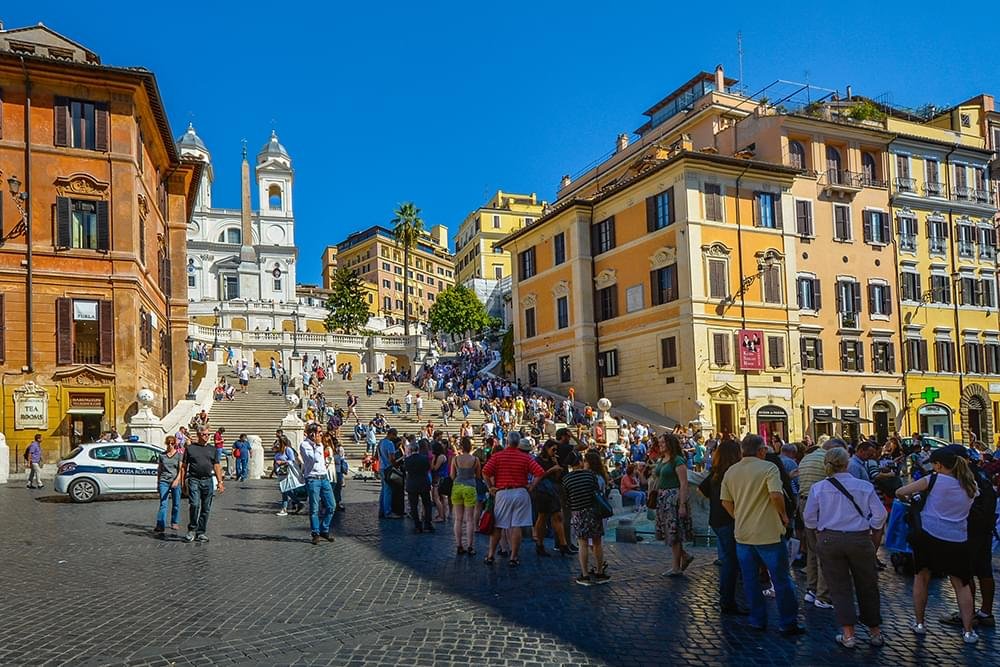
Spanish Square (Piazza di Spagna) is one of the most famous squares in Rome. It is located in a strategic position and connects to some of the most famous luxury shopping streets such as Via Condotti and Via del Babuino. These streets are lined by designer shops with such prestigious names as Valentino, Dior, Missoni, Gucci and Dolce & Gabbana. Thanks to its architectural grandeur, Piazza di Spagna also makes an excellent location for hosting grand scale events and as a perfect setting for the film industry.
Find hotels in Rome
However, Piazza di Spagna is not just an attractive location; it is also a place rich in history and architecture. The most prominent building is the Church of Trinita dei Monti which is located at the foot of the Pincio hill, overlooking the Scalinata Della Trinità dei Monti (Spanish Steps) and the Piazza di Spagna. The Church is the result of the relationship between San Francesco di Paola and King Charles VIII of France and subsequently with King Louis XII. Work began in 1502 and ended in 1519 and the facade of the Church (by Giacomo Della Porta and Domenico Fontana) has two symmetrical side towers and an obvious French influence. The interior has a single nave with a large number of chapels on each side. The Church is separated from the steps by the Obelisk Sallustiano which is located right in front of the Church and was inaugurated by Pope Pius VI in 1789.
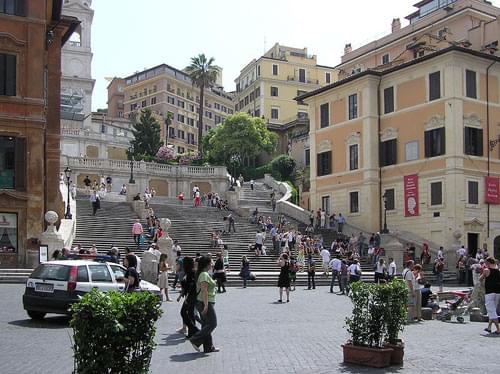
The Spanish Steps
The monumental stairway was built around 1723 at the wishes of Pope Benedict XIII. It was funded by the French and designed by Francesco De Sanctis and Alessandro Specchi. The magnificent stairway consists of more than 135 steps and was first used for the Jubilee of 1725. The function of this staircase is to link the Bourbon Spanish Embassy, after which the square is named, to the Church of Trinita dei Monti.
The staircase is also enriched by numerous terraces which, during the spring and summer, are decorated with colourful flowers making an amazing visual impact. The steps located at the end of a long road that led from the Tiber and was designed to increase the scenic effect as you approached them. It is typical of Baroque architecture, marked by very deep perspectives which culminate in impressive monumental backgrounds. In the right hand corner of the staircase is the home of the English poet John Keats, who lived and died there in 1821. Today, the home of the poet has been transformed into a museum dedicated to his memory and that of his friend Percy Bysshe Shelley. Amongst other things it is full of books keeping alive the memory of English Romanticism.
In the centre of the square, immediately at the foot of the stairs, you can find the Fontana della Barcaccia (Fountain of the Old Boat). It was built in 1627 by Pietro Bernini and his son, the famous Gian Lorenzo Bernini. It seems that the work was inspired by the story of a boat that towards the end of the 16th century ran aground when the Tiber overflowed as the result of a flood. The fountain is covered in symbols like the sun and bees and coats of arms belonging to the Pope who commissioned Bernini and son to build the fountain.
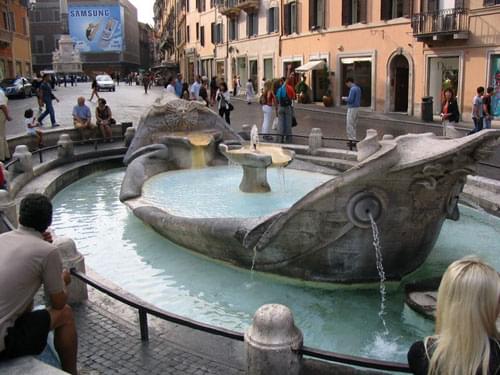
The 'Fountain of the old boat'
On the Via Frattina side of the square stands the Palazzo di Propaganda Fide (Palace of the Propagation of the Faith) which is a property of the Holy See. It was originally built as a private residence for Umbrian Mons Ferratini Bartholomew, Bishop of Amelia from 1562 to 1571. The building now houses the Museum of the Missionary Congregation for the Evangelization of Peoples. Its purpose is to present to the general public the works, objects and stories accumulated from all missionary activities in the world starting from the day of its establishment on June 22, 1622 to the present day. The front facade of this building was the originally designed by Gian Lorenzo Bernini and later by Francesco Borromini.
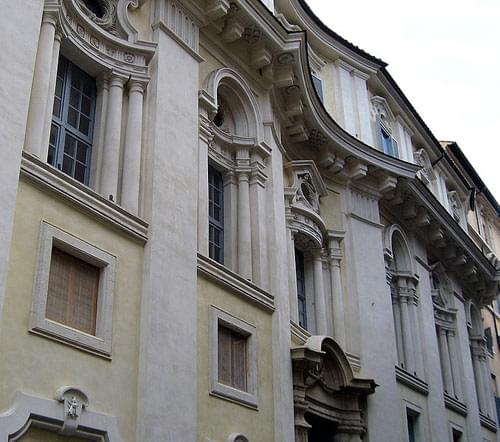
The Palace of the Propagation of the Faith
In front of the palace stands the Colonna dell'Immacolata Concezione (Column of the Immaculate Conception). It was designed by the architect Luigi Poletti and was erected on December 8th 1857 with the help of 220 fire fighters. The column has a marble base upon which stands an 11.81 metre high column that provides support for the bronze statue of the Virgin Mary made by Giuseppe Obici. At the base space there are four other statues depicting Moses (Ignatius Jacometti), David (Adam Tadolini), Isaiah (Salvatore Revelli) and Ezekiel ( Carlo Chelli). The day of the Immaculate Conception is celebrated on December 8th and every year a team of fire fighters (with the help of a crane) position a garland of flowers at the top of this column. The Pope regularly attends the ceremony extending his blessing to all present and making them free in his presence.
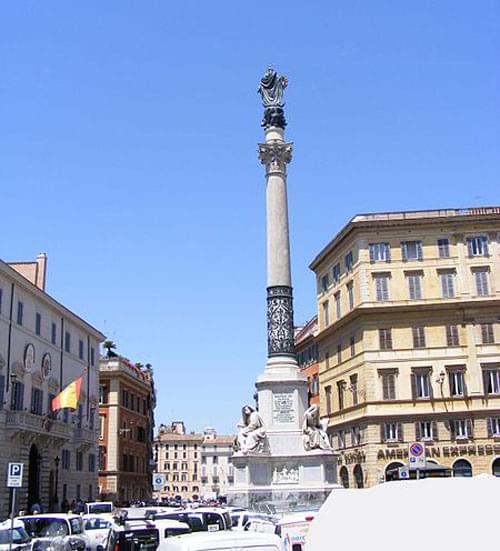
The Column of the Immaculate Conception
The Spanish Steps are easily accessible - the metro line 'A' has a station leading directly to the square. From here it is an easy walk to other key points of the city centre such as the Piazza del Popolo, Piazza Barberini, Trevi Fountain, Villa Borghese and last but not least the famous shopping street Via del Corso.