Skip to content
Nation / Famous Italians / Science / Rita Levi-Montalcini
Rita Levi-Montalcini
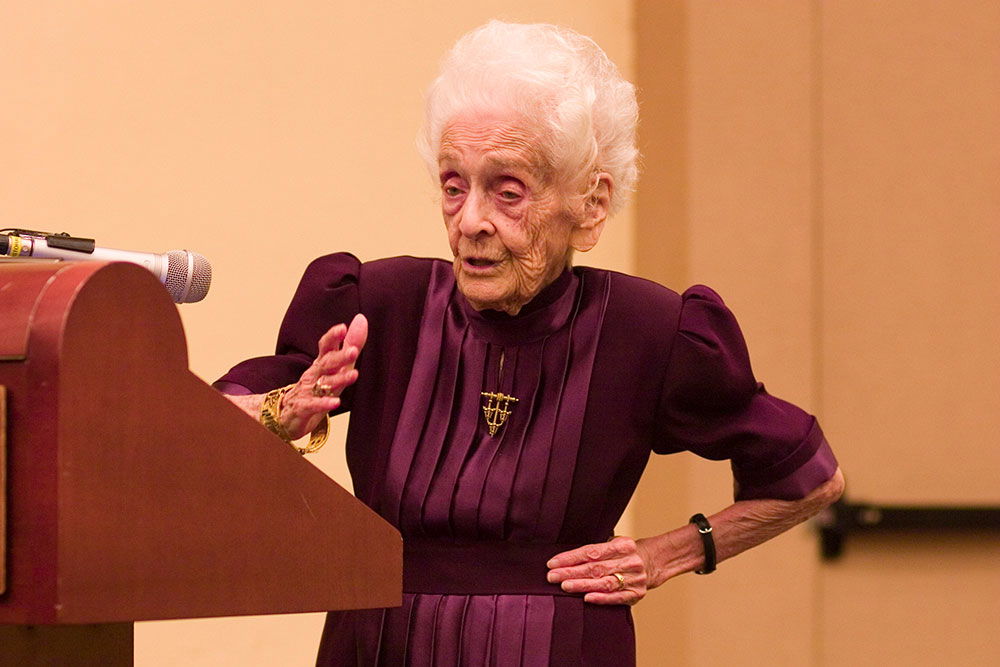
<a href="https://commons.wikimedia.org/wiki/File:NGF_%2708_Rita_Levi-Montalcini.jpg">audrey_sel</a>, <a href="https://creativecommons.org/licenses/by-sa/2.0">CC BY-SA 2.0</a>, via Wikimedia Commons

Rita Levi-Montalcini

Published:

Rita Levi-Montalcini was born on April 22, 1909, into a well-educated Jewish family in Turin, Italy. Her father, Adamo Levi, was a mathematician and electrical engineer while her mother Adele was a painter with a love for the arts.

Though her upbringing was intellectually stimulating, it also adhered to the traditional norms of the early 20th century, where women were expected to focus on domestic life. Rita, however, had no intention of following that path and felt an early pull toward academic pursuit and intellectual independence.

Choosing science against the odds

Rita decided to study medicine at the University of Turin, despite her father’s initial resistance. He feared that a professional career would compromise her future as a wife and mother, but eventually gave his reluctant support.

She was inspired by the tragic death of a close family friend from cancer, which solidified her interest in medicine and the human nervous system. She graduated summa cum laude in 1936, under the mentorship of neurohistologist Giuseppe Levi.

Life under Fascism and wartime research

With the rise of Benito Mussolini and the 1938 Italian Racial Laws that barred Jews from academic and professional careers, Levi-Montalcini was dismissed from her university post. Determined not to give up, she set up a home laboratory in her bedroom.

Using basic tools and fertilized chicken eggs, she conducted groundbreaking experiments on nerve growth, often working with little support and under great danger. Her perseverance led to discoveries that would become the foundation of her life's work.

Scientific exile and opportunity in the United States

In 1947, she accepted an invitation from Viktor Hamburger to join Washington University in St. Louis, Missouri. It was there she collaborated with biochemist Stanley Cohen and further developed her theory of nerve growth factors.

Her experiments eventually led to the identification of Nerve Growth Factor (NGF), a protein that plays a crucial role in the development and maintenance of nerve cells. This would later revolutionize the field of neurobiology.

Winning the Nobel Prize

In 1986, Rita Levi-Montalcini and Stanley Cohen were jointly awarded the Nobel Prize in Physiology or Medicine for their discovery of NGF. The award recognized decades of dedication, innovation and resilience.

Her work opened new doors in the treatment of diseases such as Alzheimer’s, Parkinson’s and certain forms of cancer. Her Nobel Prize made her an international icon of scientific achievement and female empowerment.

Legacy and commitment to society

Even in her later years, Rita remained an active figure in both science and politics. In 2001, she was appointed as a Senator for Life in the Italian Senate, continuing her advocacy for education, scientific research and women’s rights.

She also founded the Rita Levi-Montalcini Foundation, which supports the education of African girls in science and technology. Her belief in human potential, especially that of women, never faltered through her long life.

An enduring inspiration

Rita Levi-Montalcini lived to the remarkable age of 103, passing away on December 30, 2012. Her extraordinary life bridged science, politics and humanitarianism, and her contributions remain deeply relevant today.

She proved that determination, intellect and courage could overcome not only scientific challenges but also societal and political obstacles. Her story is one of the greatest testaments to the power of human resilience.

Conclusion: A woman of brilliance and bravery

Rita Levi-Montalcini was more than a Nobel laureate. She was a symbol of resistance, perseverance and visionary thinking. Her legacy continues to inspire students, scientists and dreamers around the world.

By pushing the boundaries of what was expected from a woman of her time, she opened paths that many now walk. Her life reminds us that science, like courage, knows no gender or age.

Nation Dossier

Flag of Italy

Italy

A compact nation-state reference: scale, structure, capability, and performance — designed to sit beneath articles.

Governance Economy Made in Italy Performance
Italy — national feature image
Italy at a glance — then the bigger picture: what shaped the state, how it works, what it produces, and where it stands.

Italy — global snapshot

Stable reference signals for quick orientation.

Area

301,340 km²

Covers a long peninsula extending into the Mediterranean, plus two major islands — Sicily and Sardinia — and numerous smaller island groups. The geography includes alpine regions, fertile plains, volcanic zones, and extensive coastline, shaping settlement, climate, and transport patterns.

Population

~59 million

One of the largest populations in the European Union, with density concentrated in urban and northern regions. Long-term demographic trends include low birth rates, population ageing, and increasing reliance on inward migration for workforce balance.

Coastline

~7,600 km

A predominantly maritime nation bordered by the Tyrrhenian, Adriatic, Ionian, and Ligurian seas. The extended coastline supports ports, tourism, fisheries, naval infrastructure, and a long-standing seafaring and trading tradition.

UNESCO sites

61

The highest number of UNESCO World Heritage Sites globally, spanning ancient cities, archaeological landscapes, historic centres, and cultural routes. This reflects Italy’s layered civilisations and the density of preserved cultural assets across its territory.

Currency

Euro (EUR)

Member of the Eurozone, with monetary policy set at European Central Bank level. Use of the euro facilitates trade, investment, and financial integration across the EU single market.

Time

CET / CEST

Operates on Central European Time, with daylight saving applied seasonally. The time zone aligns Italy with major European capitals, supporting coordination in business, transport, and broadcasting.

Tourism

~50–65M

Among the world’s most visited countries, attracting visitors for heritage cities, landscapes, cuisine, and lifestyle. Tourism is economically significant but regionally uneven, with strong seasonal concentration in major destinations.

Global role

G7

A founding member of the European Union and a permanent participant in G7 coordination. Italy’s influence is exercised through diplomacy, industrial capability, cultural reach, and multilateral institutions.

Governance

A layered republic

A parliamentary republic with powers and delivery spread across state, regions, and comuni — which is why outcomes can vary by territory.

Economy

Diversified, export-capable

Services dominate overall output, while manufacturing remains a defining strength through specialised clusters and global supply chains.

Made in Italy

Quality as an ecosystem

Design, craft, engineering, and brand power — often delivered by small and mid-sized firms rooted in local capability.

Performance

Strengths with constraints

World-class sectors alongside long-running challenges: uneven productivity, demographic pressure, administrative complexity, and fiscal limits.

Italy governance
Governance
Italy economy
Economy
Made in Italy
Made in Italy
Italy performance
Performance
Italy history

History

From unification to a modern republic

Modern Italy is a relatively young nation-state built from older city-states, kingdoms, and strong regional identities. Unification created the national framework, but local character remained powerful — shaping language, administration, and culture across the peninsula. The post-war republic rebuilt institutions, expanded democratic participation, and redefined the state’s relationship with citizens through welfare, education, and public infrastructure. European integration then anchored Italy within shared rules and markets, while the late 20th and 21st centuries have focused on balancing growth, reform, and cohesion in a complex, decentralised country.

Italy contribution and influence

Contribution

Europe, culture, industry

Italy’s contribution travels through EU participation, diplomacy, research networks, industrial capability, and cultural reach. In practice, influence is often most visible through specific strengths: design and heritage leadership, advanced manufacturing and specialist supply chains, food and agricultural standards, and world-class tourism and creative industries. Italy also plays a sustained role in Mediterranean and European stability through alliances, humanitarian operations, and institutional cooperation. Rather than a single narrative, Italy’s global presence is best understood as a portfolio of high-impact domains where craft, identity, and technical competence combine.