Skip to content
Nation / Famous Italians / Sport / Football / Roberto Baggio
Roberto Baggio
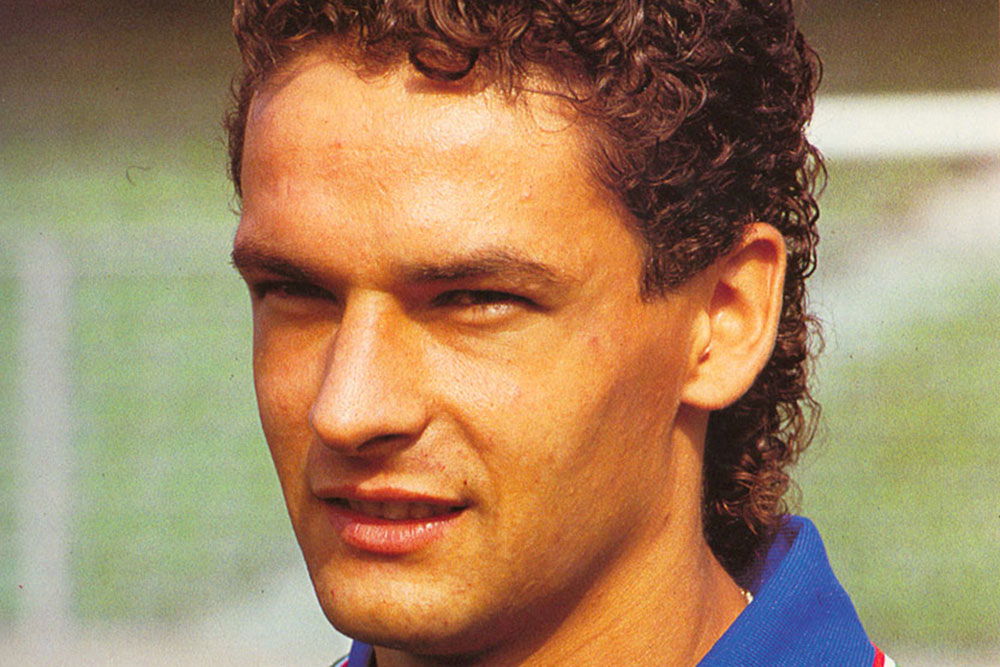
<a href="https://commons.wikimedia.org/wiki/File:Roberto_Baggio_-_Italia_%2790.jpg">Transferred from it.wikipedia to Commons.</a>, Public domain, via Wikimedia Commons

Roberto Baggio

Published:

Roberto Baggio was born on February 18, 1967, in Caldogno, a small town in northern Italy. Raised in a large family with seven siblings, Baggio showed an early passion for football, playing for hours on the streets and fields of his hometown with extraordinary flair.

By the age of nine, his talents were so obvious that he was signed by local club Caldogno. Coaches and parents alike marveled at his control, vision and ability to dribble past much older players with confidence and creativity far beyond his years.

The start of a brilliant professional career

At 15, Baggio was recruited by Vicenza, a Serie C1 club, where his rise was meteoric. His performances stunned scouts across the country and soon Fiorentina, one of Italy's top clubs, signed him in 1985.

However, his early career was quickly challenged by a devastating knee injury. He tore both his ACL and meniscus at just 18 years old, requiring multiple surgeries. Doctors doubted he would play again, but Baggio refused to give up.

Fiorentina to Juventus: talent, controversy and triumph

When Baggio finally stepped onto the pitch for Fiorentina, he became an instant icon. His ability to score from impossible angles, his calm under pressure and his grace on the ball captivated fans.

In Florence, he wasn’t just a player, he was a symbol. In 1990, his transfer to Juventus for a record-breaking fee sparked outrage among Fiorentina supporters. The move was so emotional that riots broke out in the streets.

Italia ’90 and the global rise of the divine ponytail

Roberto Baggio made his World Cup debut in 1990, scoring one of the tournament’s greatest goals against Czechoslovakia. His mazy run past defenders before slotting it calmly into the net remains etched in football history.

Though Italy exited in the semifinals, Baggio’s performances established him as one of the brightest stars in world football. His trademark ponytail, calm demeanor and spiritual depth earned him the nickname "Il Divin Codino", The Divine Ponytail.

The heartbreak and heroism of USA '94

The 1994 FIFA World Cup in the United States was both Baggio's greatest triumph and his most painful moment. He carried the Italian team through the knockout rounds, scoring crucial goals against Nigeria, Spain and Bulgaria.

In the final against Brazil, after a goalless draw, the game went to penalties. Exhausted and injured, Baggio stepped up and missed the final penalty, sending the ball over the bar. Italy lost. That miss haunted him, but also solidified his status as a tragic hero.

Later club career and ongoing battles with injury

Following the World Cup, Baggio’s career took him to AC Milan, where he won the Scudetto in 1996. Despite injuries and differences with coaches, he continued to shine whenever fit, combining creativity, intelligence and sportsmanship in every match.

He later played for Bologna, Inter Milan and finally Brescia. At each club, he brought not only goals but a sense of integrity and leadership. His performances at Brescia in the twilight of his career were among the most inspirational comebacks in Serie A history.

Faith, philosophy and personal transformation

After his 1985 injury, Baggio converted to Buddhism, finding strength and peace in his new spiritual path. He often spoke about how chanting and self-reflection helped him through physical and emotional hardships.

He remained deeply private, never seeking the limelight off the pitch. His calm presence, moral clarity and humility endeared him not just to fans but to teammates and opponents alike across the football world.

Legacy in football and influence on future generations

Roberto Baggio retired in 2004 after scoring over 200 goals in Serie A. He was inducted into the Italian Football Hall of Fame and remains a legend not just for his skill but for his spirit.

He inspired a generation of players, from Alessandro Del Piero to Francesco Totti, and even Lionel Messi has cited him as a childhood hero. Baggio’s story is often taught as a symbol of grace, endurance and excellence.

Life after football and commitment to humanity

After retiring, Baggio chose a quiet life away from coaching or television. He bought farmland, raised animals and worked with international humanitarian efforts, especially those focused on poverty and education.

He was appointed as a United Nations Food and Agriculture Organization (FAO) Goodwill Ambassador, showing the same humility and care in charity as he once did in football. His actions spoke louder than any headline.

The divine ponytail's lasting message

Roberto Baggio remains one of the most loved figures in football history, not because he was perfect, but because he was human, fragile, passionate and noble.

Whether through dazzling goals, spiritual wisdom or quiet generosity, Baggio’s legacy continues to uplift and inspire people from all walks of life. He is, and will always be, a symbol of beauty in sport and the human condition.

Nation Dossier

Flag of Italy

Italy

A compact nation-state reference: scale, structure, capability, and performance — designed to sit beneath articles.

Governance Economy Made in Italy Performance
Italy — national feature image
Italy at a glance — then the bigger picture: what shaped the state, how it works, what it produces, and where it stands.

Italy — global snapshot

Stable reference signals for quick orientation.

Area

301,340 km²

Covers a long peninsula extending into the Mediterranean, plus two major islands — Sicily and Sardinia — and numerous smaller island groups. The geography includes alpine regions, fertile plains, volcanic zones, and extensive coastline, shaping settlement, climate, and transport patterns.

Population

~59 million

One of the largest populations in the European Union, with density concentrated in urban and northern regions. Long-term demographic trends include low birth rates, population ageing, and increasing reliance on inward migration for workforce balance.

Coastline

~7,600 km

A predominantly maritime nation bordered by the Tyrrhenian, Adriatic, Ionian, and Ligurian seas. The extended coastline supports ports, tourism, fisheries, naval infrastructure, and a long-standing seafaring and trading tradition.

UNESCO sites

61

The highest number of UNESCO World Heritage Sites globally, spanning ancient cities, archaeological landscapes, historic centres, and cultural routes. This reflects Italy’s layered civilisations and the density of preserved cultural assets across its territory.

Currency

Euro (EUR)

Member of the Eurozone, with monetary policy set at European Central Bank level. Use of the euro facilitates trade, investment, and financial integration across the EU single market.

Time

CET / CEST

Operates on Central European Time, with daylight saving applied seasonally. The time zone aligns Italy with major European capitals, supporting coordination in business, transport, and broadcasting.

Tourism

~50–65M

Among the world’s most visited countries, attracting visitors for heritage cities, landscapes, cuisine, and lifestyle. Tourism is economically significant but regionally uneven, with strong seasonal concentration in major destinations.

Global role

G7

A founding member of the European Union and a permanent participant in G7 coordination. Italy’s influence is exercised through diplomacy, industrial capability, cultural reach, and multilateral institutions.

Governance

A layered republic

A parliamentary republic with powers and delivery spread across state, regions, and comuni — which is why outcomes can vary by territory.

Economy

Diversified, export-capable

Services dominate overall output, while manufacturing remains a defining strength through specialised clusters and global supply chains.

Made in Italy

Quality as an ecosystem

Design, craft, engineering, and brand power — often delivered by small and mid-sized firms rooted in local capability.

Performance

Strengths with constraints

World-class sectors alongside long-running challenges: uneven productivity, demographic pressure, administrative complexity, and fiscal limits.

Italy governance
Governance
Italy economy
Economy
Made in Italy
Made in Italy
Italy performance
Performance
Italy history

History

From unification to a modern republic

Modern Italy is a relatively young nation-state built from older city-states, kingdoms, and strong regional identities. Unification created the national framework, but local character remained powerful — shaping language, administration, and culture across the peninsula. The post-war republic rebuilt institutions, expanded democratic participation, and redefined the state’s relationship with citizens through welfare, education, and public infrastructure. European integration then anchored Italy within shared rules and markets, while the late 20th and 21st centuries have focused on balancing growth, reform, and cohesion in a complex, decentralised country.

Italy contribution and influence

Contribution

Europe, culture, industry

Italy’s contribution travels through EU participation, diplomacy, research networks, industrial capability, and cultural reach. In practice, influence is often most visible through specific strengths: design and heritage leadership, advanced manufacturing and specialist supply chains, food and agricultural standards, and world-class tourism and creative industries. Italy also plays a sustained role in Mediterranean and European stability through alliances, humanitarian operations, and institutional cooperation. Rather than a single narrative, Italy’s global presence is best understood as a portfolio of high-impact domains where craft, identity, and technical competence combine.