Skip to content
Nation / Famous Italians / Sport / Football / Alessandro Del Piero
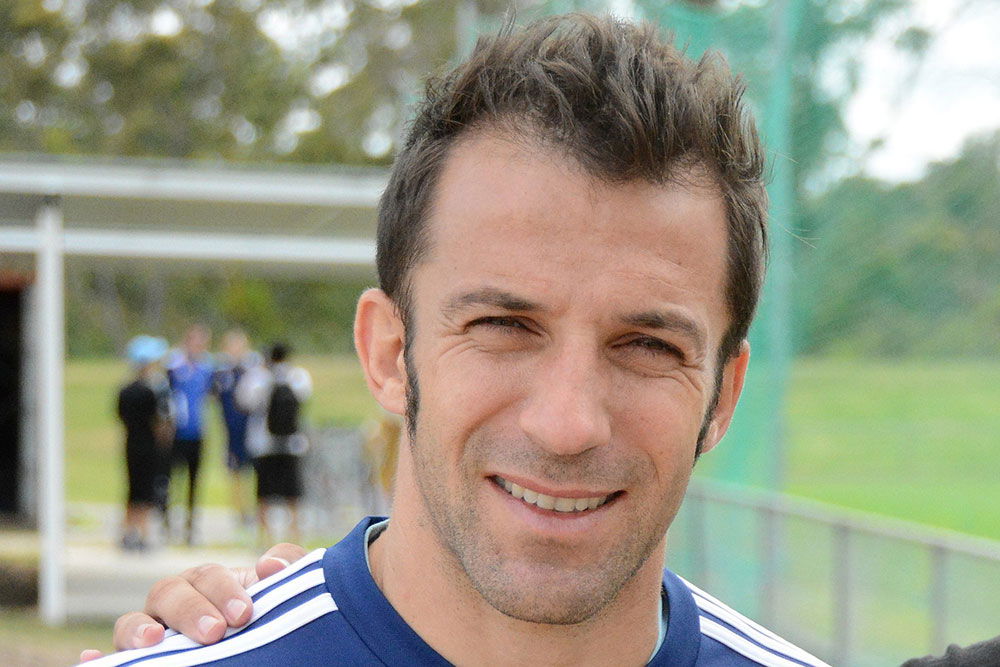
Alessandro Del Piero
<a href="https://commons.wikimedia.org/wiki/File:Alessandro_Del_Piero_in_2014.jpg">https://www.flickr.com/people/petenowakowski/</a>, <a href="https://creativecommons.org/licenses/by/2.0">CC BY 2.0</a>, via Wikimedia Commons

Alessandro Del Piero

Published:

In 1993, Del Piero joined Juventus, a club that would become his lifelong footballing home. He made an immediate impact, scoring a hat-trick in his first full start and demonstrating composure and creativity beyond his years.

Under the guidance of coach Marcello Lippi, Del Piero flourished. He developed into a versatile forward capable of playing as a second striker or left-sided attacker, known for his signature curled shots into the far corner, later dubbed the “Del Piero Goal.”

Dominating Italy and conquering Europe

Throughout the 1990s and early 2000s, Del Piero became the symbol of Juventus, leading the club to numerous titles including six Serie A championships and the 1996 UEFA Champions League. His ability to perform under pressure and his loyalty to the club made him a fan favourite.

He played with elegance and determination, often deciding tight games with moments of individual brilliance. Del Piero's consistency and class set him apart from his peers and earned him global recognition as one of the finest forwards of his era.

Facing adversity and bouncing back

Del Piero’s career was not without its challenges. In 1998, he suffered a serious knee injury that sidelined him for months and temporarily halted his momentum. Many doubted whether he could return to his best form.

With resilience and dedication, he worked tirelessly to regain his place. Though his style changed slightly after the injury, he adapted and evolved his game, becoming even more focused on intelligence, timing and set-piece mastery.

Triumph on the world stage in 2006

Del Piero’s international career spanned over a decade, and its crowning moment came at the 2006 FIFA World Cup in Germany. Though often used as a substitute, he played a crucial role in Italy’s success.

His most iconic moment came in the semi-final against Germany, where he scored a stunning goal in extra time to seal Italy’s passage to the final. He calmly converted his penalty in the shootout against France, helping his nation lift the trophy.

Leadership and loyalty through turmoil

In 2006, Juventus was relegated to Serie B following the Calciopoli scandal. While many stars left the club, Del Piero stayed, vowing to bring the team back to the top. His leadership during this period was admired across the football world.

He finished as the top scorer in Serie B and led Juventus to immediate promotion. His loyalty and commitment during the club’s darkest hour further cemented his status as a true legend and a symbol of integrity in the sport.

Breaking records and creating history

Del Piero holds the record for most goals and appearances in Juventus history, scoring over 290 goals in more than 700 matches. These numbers reflect not only talent but also longevity, discipline and love for the club.

His name is synonymous with Juventus, and his influence extends beyond statistics. Whether through a free-kick, a volley or a decisive pass, Del Piero consistently delivered moments that shaped the club’s destiny.

A graceful farewell and global respect

In 2012, Del Piero played his final match for Juventus after 19 years. His farewell was emotional, marked by tears and standing ovations as fans celebrated the end of an era. He had given everything to the club he loved.

He then moved to Sydney FC in Australia, where he brought global attention to the A-League and was hailed for his professionalism and commitment. Later, he had a brief stint in India, continuing to inspire young players around the world.

Life after football and continuing influence

After retiring, Del Piero transitioned into television, becoming a respected pundit and ambassador for the sport. He also opened a football academy to nurture talent and promote the values he embodied throughout his career.

His contributions to charity, youth development and football culture have made him a respected figure beyond the pitch. Del Piero remains involved in global football conversations, still inspiring admiration wherever the game is played.

A legacy of brilliance and humility

Alessandro Del Piero’s legacy is defined not just by goals or trophies, but by elegance, loyalty and grace. He played the game with respect, style and unwavering dedication.

His name continues to be spoken with reverence among players and fans alike. As a symbol of class in football, Del Piero will forever stand among the greatest figures in the history of the sport.

Nation Dossier

Flag of Italy

Italy

A compact nation-state reference: scale, structure, capability, and performance — designed to sit beneath articles.

Governance Economy Made in Italy Performance
Italy — national feature image
Italy at a glance — then the bigger picture: what shaped the state, how it works, what it produces, and where it stands.

Italy — global snapshot

Stable reference signals for quick orientation.

Area

301,340 km²

Covers a long peninsula extending into the Mediterranean, plus two major islands — Sicily and Sardinia — and numerous smaller island groups. The geography includes alpine regions, fertile plains, volcanic zones, and extensive coastline, shaping settlement, climate, and transport patterns.

Population

~59 million

One of the largest populations in the European Union, with density concentrated in urban and northern regions. Long-term demographic trends include low birth rates, population ageing, and increasing reliance on inward migration for workforce balance.

Coastline

~7,600 km

A predominantly maritime nation bordered by the Tyrrhenian, Adriatic, Ionian, and Ligurian seas. The extended coastline supports ports, tourism, fisheries, naval infrastructure, and a long-standing seafaring and trading tradition.

UNESCO sites

61

The highest number of UNESCO World Heritage Sites globally, spanning ancient cities, archaeological landscapes, historic centres, and cultural routes. This reflects Italy’s layered civilisations and the density of preserved cultural assets across its territory.

Currency

Euro (EUR)

Member of the Eurozone, with monetary policy set at European Central Bank level. Use of the euro facilitates trade, investment, and financial integration across the EU single market.

Time

CET / CEST

Operates on Central European Time, with daylight saving applied seasonally. The time zone aligns Italy with major European capitals, supporting coordination in business, transport, and broadcasting.

Tourism

~50–65M

Among the world’s most visited countries, attracting visitors for heritage cities, landscapes, cuisine, and lifestyle. Tourism is economically significant but regionally uneven, with strong seasonal concentration in major destinations.

Global role

G7

A founding member of the European Union and a permanent participant in G7 coordination. Italy’s influence is exercised through diplomacy, industrial capability, cultural reach, and multilateral institutions.

Governance

A layered republic

A parliamentary republic with powers and delivery spread across state, regions, and comuni — which is why outcomes can vary by territory.

Economy

Diversified, export-capable

Services dominate overall output, while manufacturing remains a defining strength through specialised clusters and global supply chains.

Made in Italy

Quality as an ecosystem

Design, craft, engineering, and brand power — often delivered by small and mid-sized firms rooted in local capability.

Performance

Strengths with constraints

World-class sectors alongside long-running challenges: uneven productivity, demographic pressure, administrative complexity, and fiscal limits.

Italy governance
Governance
Italy economy
Economy
Made in Italy
Made in Italy
Italy performance
Performance
Italy history

History

From unification to a modern republic

Modern Italy is a relatively young nation-state built from older city-states, kingdoms, and strong regional identities. Unification created the national framework, but local character remained powerful — shaping language, administration, and culture across the peninsula. The post-war republic rebuilt institutions, expanded democratic participation, and redefined the state’s relationship with citizens through welfare, education, and public infrastructure. European integration then anchored Italy within shared rules and markets, while the late 20th and 21st centuries have focused on balancing growth, reform, and cohesion in a complex, decentralised country.

Italy contribution and influence

Contribution

Europe, culture, industry

Italy’s contribution travels through EU participation, diplomacy, research networks, industrial capability, and cultural reach. In practice, influence is often most visible through specific strengths: design and heritage leadership, advanced manufacturing and specialist supply chains, food and agricultural standards, and world-class tourism and creative industries. Italy also plays a sustained role in Mediterranean and European stability through alliances, humanitarian operations, and institutional cooperation. Rather than a single narrative, Italy’s global presence is best understood as a portfolio of high-impact domains where craft, identity, and technical competence combine.