Skip to content
Nation / Famous Italians / Sport / Skiing / Federica Brignone
Federika Brignone
<a href="https://de.wikipedia.org/wiki/User:2eight" class="extiw" title="de:User:2eight">Stefan Brending</a>

Federika Brignone

Published:

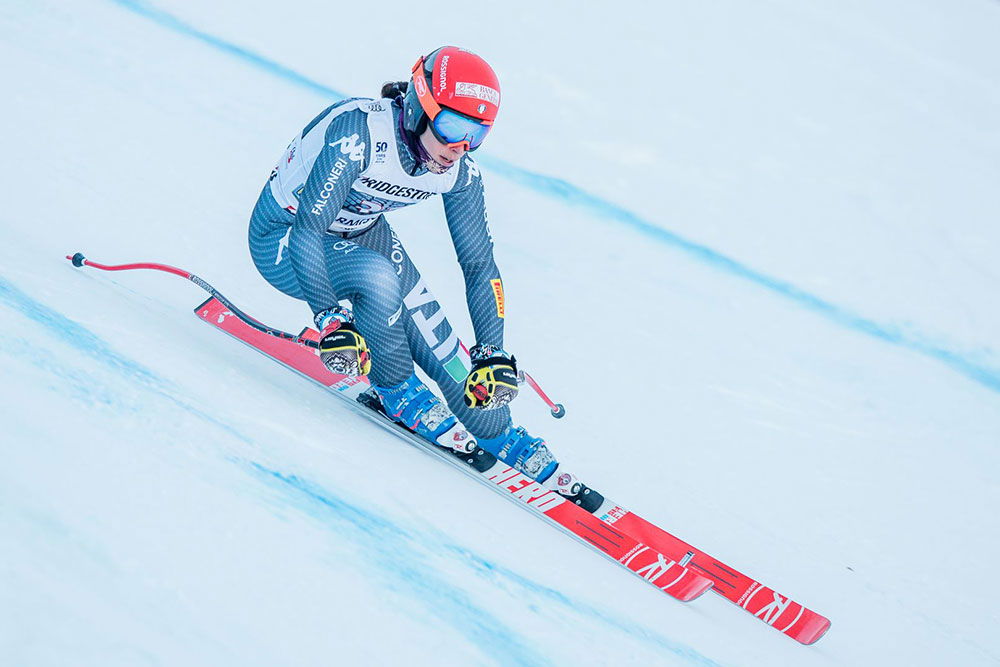
Federica Brignone is more than just a world-class skier, she is a national treasure. As Italy’s most decorated female Alpine ski racer, Brignone has carved her name into the history books with her fearless style, technical brilliance, and unwavering dedication. With an overall World Cup title, multiple Olympic medals, and over 50 World Cup podiums, her career is a testament to excellence in a sport that demands both precision and courage.

Early Life and Family Legacy

Born on July 14, 1990, in Milan, Italy, Federica grew up in a family where skiing was a way of life. Her mother, Maria Rosa Quario, was a former World Cup alpine ski racer herself, winning several slalom races in the 1980s. Encouraged by her family, Federica hit the slopes at a young age and quickly showed a natural flair for racing.

Raised between Milan and the mountain resort of La Salle in the Aosta Valley, Brignone developed her technique on some of Italy’s most challenging terrains, preparing her for the highest levels of international competition.

Rising Through the Ranks

Brignone made her World Cup debut in December 2007 at the age of 17. By 2011, she had already captured attention with a silver medal in Giant Slalom at the FIS Alpine World Ski Championships in Garmisch-Partenkirchen. It was clear she had the potential to be one of Italy’s greats.

Despite a few seasons interrupted by injury, Brignone’s drive never wavered. Her breakthrough came in 2015 and 2016, when she began winning regularly on the World Cup circuit, especially in Giant Slalom and Super-G disciplines.

A Historic World Cup Title

In the 2019–2020 season, Federica Brignone made history. With consistent podium finishes across disciplines, including Giant Slalom, Super-G, and Alpine Combined, she won the overall World Cup title, becoming:

  • The first Italian woman ever to win the Overall Crystal Globe

She finished that season with 5 race wins and 11 podiums, a feat unmatched by any of her Italian predecessors.

Career World Cup Highlights (as of 2025):

  • Overall World Cup Champion (2019–2020)
  • Multiple World Cup discipline titles
  • Over 23 individual World Cup wins
  • 50+ World Cup podium finishes

Olympic Success and Consistency

Federica Brignone is also an Olympic medalist, having competed in four Olympic Games:

  • 2018 PyeongChang: Bronze in Giant Slalom
  • 2022 Beijing: Silver in Giant Slalom, Bronze in Alpine Combined

Her ability to perform on the biggest stage adds to her reputation as one of the most complete and reliable skiers in the sport. Unlike many skiers who specialize in one or two events, Brignone excels in Giant Slalom, Super-G, and Combined, making her a threat in any race.

Sustainability and Life Beyond the Slopes

Off the slopes, Brignone is known for her commitment to environmental sustainability. In 2017, she launched the "Traiettorie Liquide" project to raise awareness about plastic pollution in oceans and promote sustainable practices. This initiative, combining art, sport, and science, shows another side of Brignone: a passionate advocate for the planet.

She is also a popular figure in Italy’s media, appearing in interviews, documentaries, and sports features, always representing her sport with class and intelligence.

A Role Model for the Next Generation

Federica Brignone's influence goes beyond her race wins. She is a role model for young athletes, especially women in sports, for her:

  • Long-term consistency
  • Grit in overcoming injuries
  • Passion for skiing
  • Commitment to causes beyond sport

Her family legacy, elite performances, and authentic personality have made her one of Italy’s most beloved athletes.

Looking Ahead: 2025 and Beyond

As of the 2024–2025 Alpine Ski World Cup season, Brignone continues to compete at the highest level, regularly challenging younger athletes and holding her own among the world’s best. With the 2026 Winter Olympics in Milan-Cortina on the horizon, Italian fans are hopeful to see her race on home snow, potentially marking a poetic finale to a legendary career.

Conclusion: A Legend in Motion

Federica Brignone’s career is already the stuff of legends. Her achievements place her among the greatest skiers in history, and her continued presence on the World Cup circuit is a gift to fans of the sport. Whether she’s skiing, advocating for the environment, or mentoring the next generation, Federica Brignone is a name that will inspire for decades to come.

Nation Dossier

Flag of Italy

Italy

A compact nation-state reference: scale, structure, capability, and performance — designed to sit beneath articles.

Governance Economy Made in Italy Performance
Italy — national feature image
Italy at a glance — then the bigger picture: what shaped the state, how it works, what it produces, and where it stands.

Italy — global snapshot

Stable reference signals for quick orientation.

Area

301,340 km²

Covers a long peninsula extending into the Mediterranean, plus two major islands — Sicily and Sardinia — and numerous smaller island groups. The geography includes alpine regions, fertile plains, volcanic zones, and extensive coastline, shaping settlement, climate, and transport patterns.

Population

~59 million

One of the largest populations in the European Union, with density concentrated in urban and northern regions. Long-term demographic trends include low birth rates, population ageing, and increasing reliance on inward migration for workforce balance.

Coastline

~7,600 km

A predominantly maritime nation bordered by the Tyrrhenian, Adriatic, Ionian, and Ligurian seas. The extended coastline supports ports, tourism, fisheries, naval infrastructure, and a long-standing seafaring and trading tradition.

UNESCO sites

61

The highest number of UNESCO World Heritage Sites globally, spanning ancient cities, archaeological landscapes, historic centres, and cultural routes. This reflects Italy’s layered civilisations and the density of preserved cultural assets across its territory.

Currency

Euro (EUR)

Member of the Eurozone, with monetary policy set at European Central Bank level. Use of the euro facilitates trade, investment, and financial integration across the EU single market.

Time

CET / CEST

Operates on Central European Time, with daylight saving applied seasonally. The time zone aligns Italy with major European capitals, supporting coordination in business, transport, and broadcasting.

Tourism

~50–65M

Among the world’s most visited countries, attracting visitors for heritage cities, landscapes, cuisine, and lifestyle. Tourism is economically significant but regionally uneven, with strong seasonal concentration in major destinations.

Global role

G7

A founding member of the European Union and a permanent participant in G7 coordination. Italy’s influence is exercised through diplomacy, industrial capability, cultural reach, and multilateral institutions.

Governance

A layered republic

A parliamentary republic with powers and delivery spread across state, regions, and comuni — which is why outcomes can vary by territory.

Economy

Diversified, export-capable

Services dominate overall output, while manufacturing remains a defining strength through specialised clusters and global supply chains.

Made in Italy

Quality as an ecosystem

Design, craft, engineering, and brand power — often delivered by small and mid-sized firms rooted in local capability.

Performance

Strengths with constraints

World-class sectors alongside long-running challenges: uneven productivity, demographic pressure, administrative complexity, and fiscal limits.

Italy governance
Governance
Italy economy
Economy
Made in Italy
Made in Italy
Italy performance
Performance
Italy history

History

From unification to a modern republic

Modern Italy is a relatively young nation-state built from older city-states, kingdoms, and strong regional identities. Unification created the national framework, but local character remained powerful — shaping language, administration, and culture across the peninsula. The post-war republic rebuilt institutions, expanded democratic participation, and redefined the state’s relationship with citizens through welfare, education, and public infrastructure. European integration then anchored Italy within shared rules and markets, while the late 20th and 21st centuries have focused on balancing growth, reform, and cohesion in a complex, decentralised country.

Italy contribution and influence

Contribution

Europe, culture, industry

Italy’s contribution travels through EU participation, diplomacy, research networks, industrial capability, and cultural reach. In practice, influence is often most visible through specific strengths: design and heritage leadership, advanced manufacturing and specialist supply chains, food and agricultural standards, and world-class tourism and creative industries. Italy also plays a sustained role in Mediterranean and European stability through alliances, humanitarian operations, and institutional cooperation. Rather than a single narrative, Italy’s global presence is best understood as a portfolio of high-impact domains where craft, identity, and technical competence combine.