Skip to content
Nation / Famous Italians / Sport / Motorcycle Racing / Marco Simoncelli
Marco Simoncelli
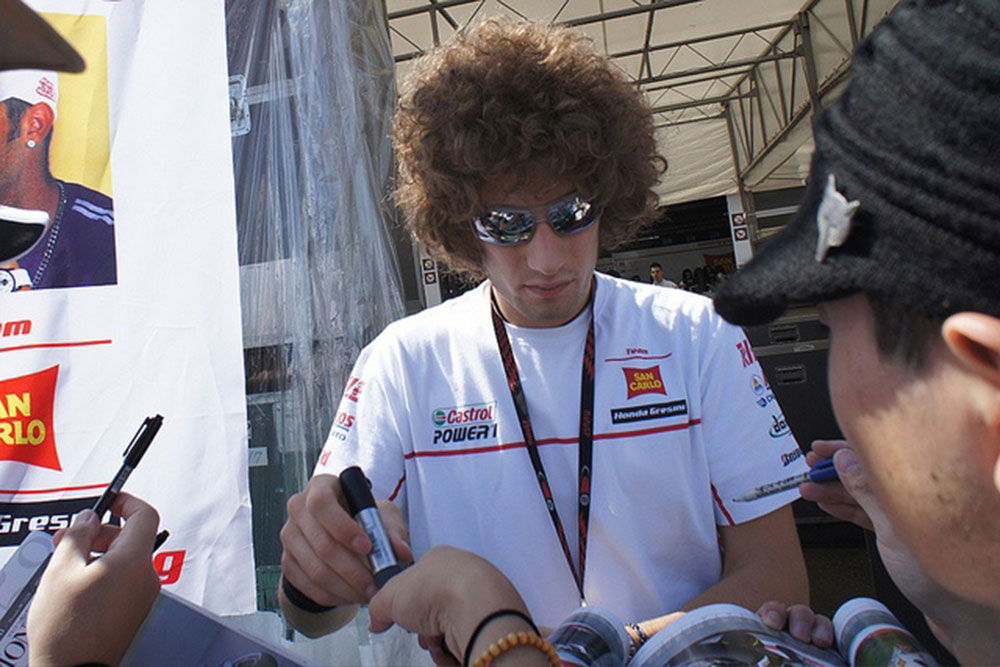
<a href="https://commons.wikimedia.org/wiki/File:Simoncelli_2010.jpg">Ranpie</a>, <a href="https://creativecommons.org/licenses/by-sa/2.0">CC BY-SA 2.0</a>, via Wikimedia Commons

Marco Simoncelli

Published:

Marco Simoncelli was born on January 20, 1987 in the Province of Rimini, Italy, a region with a deep-rooted passion for motorsports. His love for racing was apparent from an early age, and by the time he was seven, he was already competing in minibike events.

Backed by a supportive family and driven by a fearless spirit, Simoncelli quickly climbed through the local racing ranks. His wild curls and boundless energy made him stand out, but it was his skill and bravery that earned him national attention.

Climbing the ranks of competitive racing

Simoncelli’s professional career began in 2002 in the 125cc World Championship. He joined the Matteoni Racing team and showed promise from his first season. He scored his first podium in 2003 and took his first win in 2004, revealing a future star.

He moved up to the 250cc class in 2006 and it was here that he would solidify his status as a world-class racer. Riding for Gilera, a historic Italian brand, Simoncelli won the 2008 250cc World Championship, the highlight of his early career.

The rise to MotoGP and global recognition

In 2010, Simoncelli graduated to MotoGP, joining the San Carlo Honda Gresini team. Despite the challenges of adapting to the faster and more competitive category, he quickly became a fan favorite due to his aggressive riding style and vibrant personality.

His performances were often unpredictable but always electrifying. Whether battling at the front or staging dramatic comebacks, Simoncelli brought energy and drama to every race, capturing the imagination of fans around the world.

Racing style and controversial moments

Simoncelli’s riding was both admired and criticized. He raced with raw aggression, often taking risks that others avoided. His late braking, fierce cornering, and never-back-down attitude made him a thrilling presence on the track.

This boldness sometimes led to controversial clashes with rivals. In particular, his incidents with Dani Pedrosa and Jorge Lorenzo sparked heated debates. Still, many respected his honesty and willingness to learn from his mistakes.

A magnetic personality and fan favorite

Off the track, Simoncelli was charismatic, humorous, and unfiltered. His honesty in interviews and his disheveled, rock-star appearance made him stand out in a sport full of polished personas.

He built a loyal fanbase that extended far beyond Italy, admired not only for his racing talent but also for his authenticity. He represented the joy and danger of motorcycle racing in a way few others could.

The tragedy of Sepang and global mourning

On October 23, 2011, during the Malaysian Grand Prix at Sepang, Simoncelli lost control of his bike on the second lap and was tragically struck by two following riders. He died from his injuries shortly after.

His death shocked the motorsport world. At just 24 years old, Simoncelli was reaching his prime and had only begun to show what he was truly capable of in MotoGP. Tributes poured in from fans, teams, and fellow racers across the globe.

A legacy that continues to inspire

The loss of Marco Simoncelli left an enormous void in MotoGP, but his spirit continues to inspire young racers. The number 58, which he wore with pride, became a symbol of bravery and passion in motorcycle racing.

In 2012, the Misano World Circuit in Rimini Province was renamed Misano World Circuit Marco Simoncelli, a fitting tribute in the region that raised him. His story remains a touchstone for fans and racers who celebrate heart over caution.

The Simoncelli Foundation and humanitarian work

After his passing, the Simoncelli family established the Marco Simoncelli Foundation to support disabled individuals and promote social initiatives. The foundation embodies the generosity and joy that Marco brought to those around him.

Through charity events, scholarships, and local projects in Rimini Province, the foundation ensures that Marco’s name is not only remembered on race tracks but also associated with helping others in need.

The memory of SuperSic in motorsport culture

Nicknamed “SuperSic,” Simoncelli became more than a racer—he became a cultural icon. His merchandise is still worn proudly by fans at circuits around the world, and his image is immortalized in murals, documentaries, and books.

Riders often dedicate victories to him, and many wear the number 58 or include tributes on their helmets. His name continues to echo in the paddock, a reminder of courage and individuality in a highly competitive sport.

Conclusion: forever young, forever fast

Marco Simoncelli’s career was tragically brief but deeply impactful. He raced with the kind of abandon that made him unforgettable, refusing to conform to expectations or play it safe.

Though he never had the chance to win a MotoGP title, his legacy is larger than any championship. Marco Simoncelli remains a symbol of youthful energy, fearlessness, and passion that defines the soul of motorcycle racing.

Nation Dossier

Flag of Italy

Italy

A compact nation-state reference: scale, structure, capability, and performance — designed to sit beneath articles.

Governance Economy Made in Italy Performance
Italy — national feature image
Italy at a glance — then the bigger picture: what shaped the state, how it works, what it produces, and where it stands.

Italy — global snapshot

Stable reference signals for quick orientation.

Area

301,340 km²

Covers a long peninsula extending into the Mediterranean, plus two major islands — Sicily and Sardinia — and numerous smaller island groups. The geography includes alpine regions, fertile plains, volcanic zones, and extensive coastline, shaping settlement, climate, and transport patterns.

Population

~59 million

One of the largest populations in the European Union, with density concentrated in urban and northern regions. Long-term demographic trends include low birth rates, population ageing, and increasing reliance on inward migration for workforce balance.

Coastline

~7,600 km

A predominantly maritime nation bordered by the Tyrrhenian, Adriatic, Ionian, and Ligurian seas. The extended coastline supports ports, tourism, fisheries, naval infrastructure, and a long-standing seafaring and trading tradition.

UNESCO sites

61

The highest number of UNESCO World Heritage Sites globally, spanning ancient cities, archaeological landscapes, historic centres, and cultural routes. This reflects Italy’s layered civilisations and the density of preserved cultural assets across its territory.

Currency

Euro (EUR)

Member of the Eurozone, with monetary policy set at European Central Bank level. Use of the euro facilitates trade, investment, and financial integration across the EU single market.

Time

CET / CEST

Operates on Central European Time, with daylight saving applied seasonally. The time zone aligns Italy with major European capitals, supporting coordination in business, transport, and broadcasting.

Tourism

~50–65M

Among the world’s most visited countries, attracting visitors for heritage cities, landscapes, cuisine, and lifestyle. Tourism is economically significant but regionally uneven, with strong seasonal concentration in major destinations.

Global role

G7

A founding member of the European Union and a permanent participant in G7 coordination. Italy’s influence is exercised through diplomacy, industrial capability, cultural reach, and multilateral institutions.

Governance

A layered republic

A parliamentary republic with powers and delivery spread across state, regions, and comuni — which is why outcomes can vary by territory.

Economy

Diversified, export-capable

Services dominate overall output, while manufacturing remains a defining strength through specialised clusters and global supply chains.

Made in Italy

Quality as an ecosystem

Design, craft, engineering, and brand power — often delivered by small and mid-sized firms rooted in local capability.

Performance

Strengths with constraints

World-class sectors alongside long-running challenges: uneven productivity, demographic pressure, administrative complexity, and fiscal limits.

Italy governance
Governance
Italy economy
Economy
Made in Italy
Made in Italy
Italy performance
Performance
Italy history

History

From unification to a modern republic

Modern Italy is a relatively young nation-state built from older city-states, kingdoms, and strong regional identities. Unification created the national framework, but local character remained powerful — shaping language, administration, and culture across the peninsula. The post-war republic rebuilt institutions, expanded democratic participation, and redefined the state’s relationship with citizens through welfare, education, and public infrastructure. European integration then anchored Italy within shared rules and markets, while the late 20th and 21st centuries have focused on balancing growth, reform, and cohesion in a complex, decentralised country.

Italy contribution and influence

Contribution

Europe, culture, industry

Italy’s contribution travels through EU participation, diplomacy, research networks, industrial capability, and cultural reach. In practice, influence is often most visible through specific strengths: design and heritage leadership, advanced manufacturing and specialist supply chains, food and agricultural standards, and world-class tourism and creative industries. Italy also plays a sustained role in Mediterranean and European stability through alliances, humanitarian operations, and institutional cooperation. Rather than a single narrative, Italy’s global presence is best understood as a portfolio of high-impact domains where craft, identity, and technical competence combine.