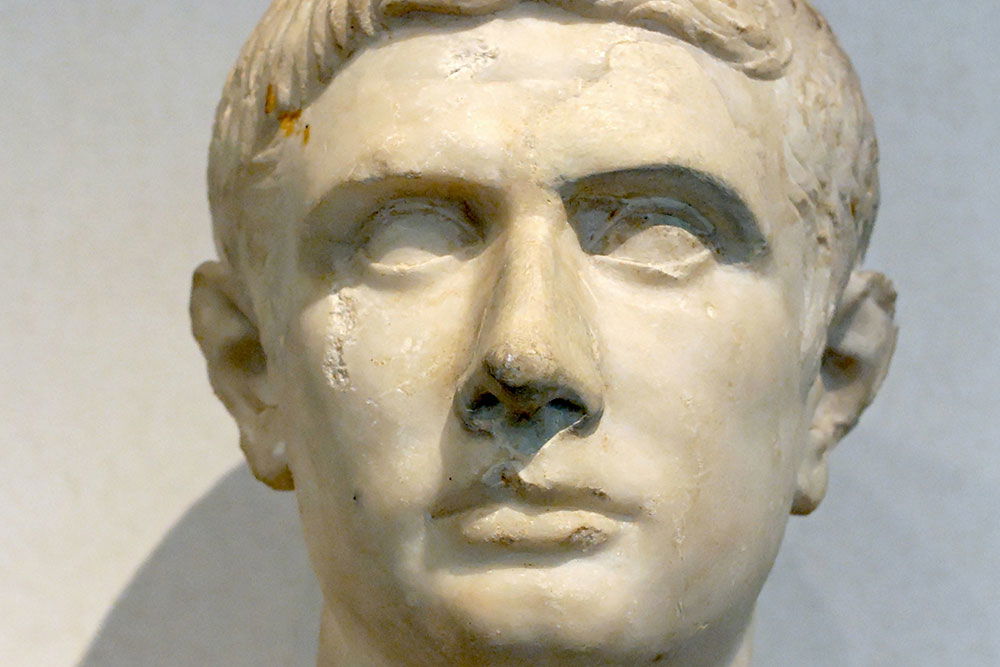
Marcus Junius Brutus was born in 85 BCE into a family with deep ties to the Roman Republic. His mother, Servilia, was a member of the powerful Junia family and closely connected to the political elite.
Brutus’ father was killed by Pompey the Great during the political purges of the early 1st century BCE. Despite this, Brutus would later develop strong political and personal alliances with both Caesar and Pompey.
Brutus and the Roman Republic
Brutus grew up with the ideals of the Republic deeply rooted in his mind. He was educated in philosophy and oratory and was especially drawn to Stoicism, which emphasized duty, reason and self-control.
These ideals shaped his worldview and his sense of justice. He saw himself as a defender of the Republic, a man bound by moral duty rather than personal ambition.
Friendship with Julius Caesar
Despite being raised with Republican ideals, Brutus eventually formed a complex relationship with Julius Caesar. Caesar was his mother’s lover and treated Brutus with affection and trust.
Brutus even sided with Caesar after the Battle of Pharsalus in 48 BCE, despite Caesar’s defeat of Pompey, whom Brutus had previously supported. This personal loyalty would soon face a major test.
The growing power of Caesar
As Caesar consolidated power and was declared dictator for life, many in the Senate feared the end of the Republic. Brutus found himself torn between loyalty to Caesar and loyalty to Rome.
Caesar's increasing dominance seemed to threaten the traditional Republican structure. Brutus, along with other senators, began to believe that action was necessary to save the Republic.
The Ides of March conspiracy
The conspiracy against Caesar formed among a group of senators who called themselves the Liberators. They believed Caesar’s death would restore the Republic. Brutus was a key figure in the plot.
Despite his personal relationship with Caesar, Brutus agreed to participate, convinced that removing Caesar was for the greater good. The plan was carefully timed and executed.
The assassination of Caesar
On March 15, 44 BCE, Brutus and the conspirators struck. Caesar was stabbed 23 times on the floor of the Senate. According to tradition, Caesar’s final words were “Et tu, Brute?”
These words, meaning “You too, Brutus?” highlighted the deep personal betrayal. Brutus later defended his actions in a speech to the Roman people, believing they would understand.
The reaction of the Roman people
Instead of restoring order, Caesar’s murder plunged Rome into chaos. The people did not celebrate Caesar’s death, and many were horrified by the brutality of the act.
Mark Antony’s funeral speech turned public opinion against the assassins. Riots erupted and Brutus and his fellow conspirators were forced to flee the city.
Brutus in the East
Brutus escaped to Greece where he began to raise an army. Along with his co-conspirator Cassius, he gathered forces to defend their vision of the Republic against Caesar’s supporters.
Their opponents included Mark Antony and Octavian, Caesar’s heir. The stage was set for a massive civil war that would determine the future of Rome.
The Battle of Philippi
In 42 BCE, the two armies met in the Battle of Philippi. Brutus and Cassius faced the forces of Antony and Octavian in one of the most significant battles in Roman history.
After an initial success, Cassius mistakenly believed Brutus had lost and committed suicide. Brutus continued the fight but was eventually defeated and also took his own life.
The legacy of Brutus
Brutus' death marked the end of the Republican resistance. His actions are still debated today, with some viewing him as a hero who tried to save the Republic, others as a traitor.
His story was immortalized by Shakespeare and continues to inspire discussions about power, loyalty and freedom. Brutus remains one of the most complex figures in ancient history.
Brutus in literature and philosophy
Writers and philosophers have long debated the ethics of Brutus’ choice. Shakespeare’s "Julius Caesar" made him a tragic hero torn between conflicting loyalties.
In modern thought, Brutus is often seen as a symbol of idealism corrupted by politics. He embodies the tension between personal friendship and political principle.
Was Brutus right?
The question remains whether Brutus was right to kill Caesar. By acting, he hoped to preserve liberty and Republican values, yet his decision led to civil war and dictatorship.
Octavian, later known as Augustus, would become Rome’s first emperor. Ironically, the Republic Brutus died for was never restored, raising questions about the cost of his ideals.
Conclusion: Brutus and the meaning of duty
Brutus was not simply a villain or a hero. He was a man shaped by philosophy, politics and personal relationships, navigating one of the most dangerous periods in Roman history.
His life invites us to reflect on what it means to serve a higher cause and whether ends truly justify means. Brutus’ story is a timeless lesson in the challenges of political morality.