
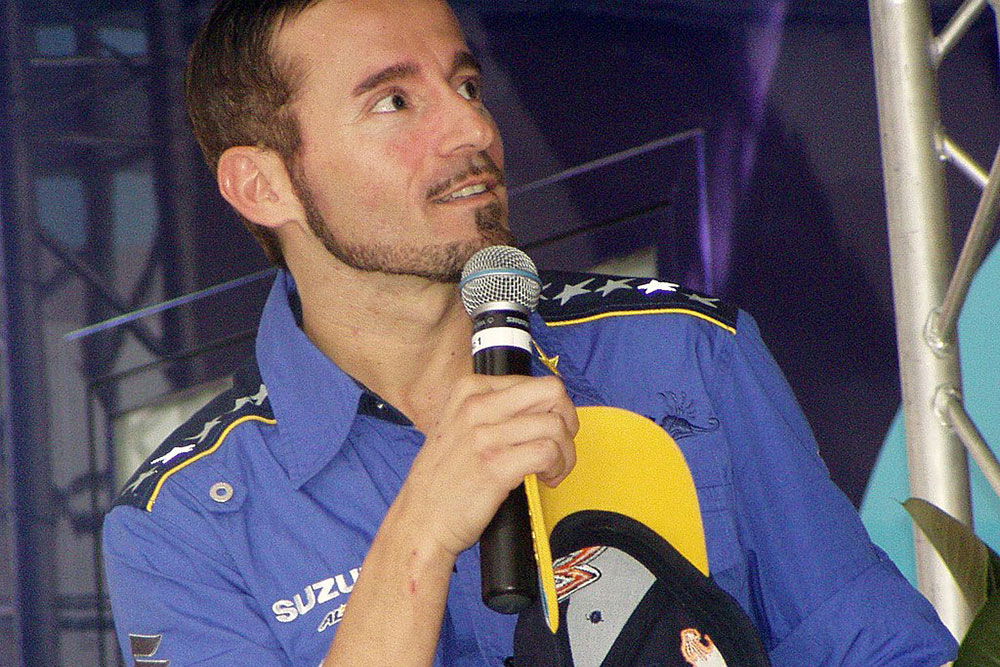
Max Biaggi
Born on June 26, 1971 in Rome Province, Italy, Max Biaggi grew up far from the glitz of elite motorsport. He was raised in a middle-class neighborhood, where his passion for motorcycles began not in luxury but in curiosity and grit.
His first motorbike experience came at age 17, considered a late start in the competitive racing world. But Biaggi’s determination and raw talent quickly outshone his peers, allowing him to catch up to riders who had years more experience.
Rise through the 250cc world championship
Biaggi’s professional debut came in 1991 in the 250cc World Championship. He joined the Aprilia team, one of Italy’s most prestigious manufacturers, and within just a few seasons, he became a dominant force in the category.
From 1994 to 1997, Biaggi won four consecutive 250cc World Championships. His precision riding, elegant posture, and ability to control races from the front earned him the nickname "The Roman Emperor" and made him a national icon in Italy.
Transition to MotoGP and global fame
In 1998, Biaggi made the leap to the premier class, MotoGP, then known as the 500cc class. He made an immediate impact by winning his very first MotoGP race with Honda, a rare achievement that underlined his natural talent.
His career in MotoGP saw him race for top teams including Yamaha and Honda, facing fierce rivalries, most notably with Valentino Rossi. This rivalry became one of the sport's most talked-about battles, marked by intense on-track competition and off-track tension.
The Rossi-Biaggi rivalry that shook MotoGP
Few rivalries in motorsport history were as explosive as that between Max Biaggi and Valentino Rossi. Both hailed from Italy, but their approaches to fame, fans, and racing could not have been more different.
Biaggi was polished, private, and fiercely competitive, while Rossi was playful and crowd-friendly. Their collisions both literal and verbal captivated fans, adding drama to every race and elevating MotoGP’s global profile during the early 2000s.
Biaggi’s final MotoGP years and departure
Despite consistently strong performances, Biaggi never secured a MotoGP world title. He came closest in 2001 and 2002 but often found himself just behind the dominant figures of the era.
In 2005, after a tough season with Repsol Honda, Biaggi was controversially left without a ride for 2006. His departure from MotoGP was unexpected, marking the end of an era for one of Italy’s greatest motorcycle talents.
Rebirth in World Superbike and historic victories
Biaggi’s career was far from over. In 2007, he switched to the World Superbike Championship, joining the Sterilgarda Ducati team. He later partnered with Aprilia, returning to his roots with the Italian manufacturer.
In 2010, Biaggi made history by winning the World Superbike Championship, becoming the first Italian ever to do so. He repeated the feat in 2012, proving his enduring skill and etching his name among the greats of two-wheel racing.
Riding style and technical mastery
Max Biaggi’s riding was defined by precision. He was known for his smooth throttle control, disciplined lines, and the rare ability to maintain tire life without compromising speed.
This methodical style contrasted with the more aggressive riders of his generation, yet it made him one of the most consistent performers over two decades of elite competition.
Legacy and influence on Italian motorsport
Biaggi’s impact on Italian motorsport is profound. He inspired a generation of riders from Rome Province and across Italy, paving the way for others to pursue careers at the sport’s highest levels.
His influence is evident in young racers who emulate his technique and professionalism. Biaggi remains active as a mentor, team ambassador, and commentator, ensuring his legacy endures beyond his racing years.
Personal life, public image, and beyond racing
Outside the racetrack, Biaggi has maintained a relatively private life. He has had high-profile relationships, including with pop star Bianca Atzei, but keeps his personal affairs discreet.
He has occasionally been seen at fashion events and motorsport festivals, but his focus has always returned to racing. His controlled image contrasts with his explosive racing past, revealing a complex and focused individual.
Max Biaggi today and his continuing role
Today, Max Biaggi remains involved in the racing world. He serves as a team manager and technical advisor, particularly with young Italian riders in Moto3 and Moto2 circuits.
His insights are frequently sought in broadcast commentary and motorsport journalism, and he continues to be celebrated at racing events worldwide as one of Italy’s greatest champions.
Conclusion: the Roman Emperor of the racetrack
Max Biaggi’s story is not just one of victories and rivalries, but of longevity, precision, and passion. From Rome Province to world podiums, his path was shaped by relentless drive and natural ability.
In both MotoGP and World Superbike, Biaggi achieved what few could: sustained excellence across eras. His legend continues to inspire riders around the globe.


