Skip to content
Nation / Famous Italians / Prime Ministers / Giuseppe Conte
Giuseppe Conte
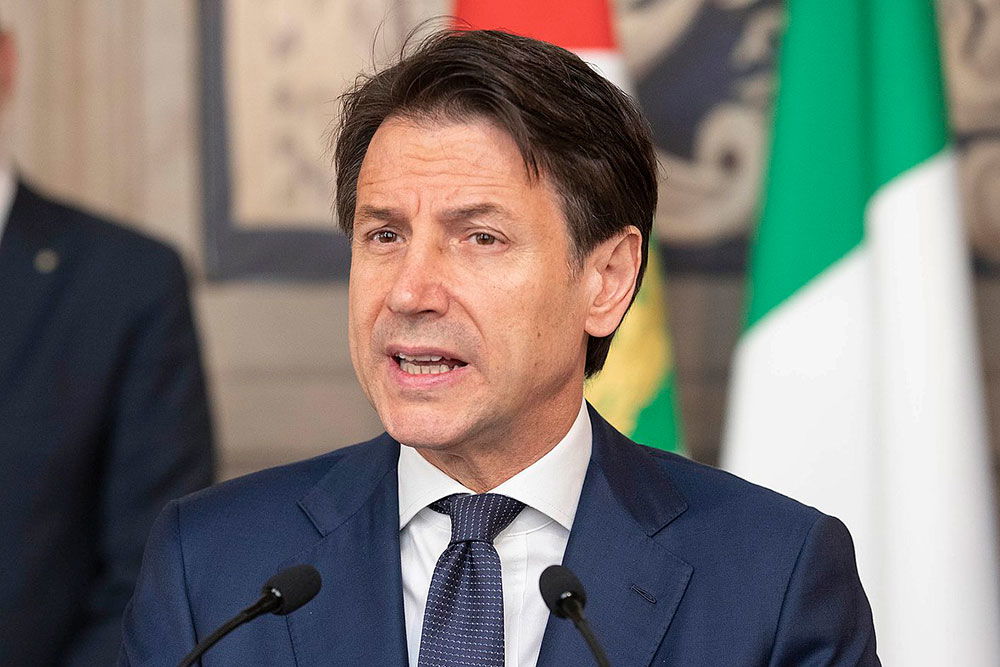
<a href="https://commons.wikimedia.org/wiki/File:Giuseppe_Conte_Quirinale_2019.jpg">Presidency of the Italian Republic</a>, Attribution, via Wikimedia Commons

Giuseppe Conte

Published:

Giuseppe Conte was born on August 8, 1964, in Volturara Appula, a small town in the Apulia province of southern Italy. He pursued a career in law and became a respected professor known for his academic rigor and command of civil law.

His expertise led him to hold positions at top Italian universities and study at prestigious institutions abroad including Yale and New York University. Conte remained largely unknown outside academic and legal circles until his abrupt entrance into politics in 2018.

Unexpected rise to the premiership

In 2018 Italy faced a political stalemate following general elections and an unusual coalition formed between the anti-establishment Five Star Movement and the right-wing League. With neither party leader willing to serve as Prime Minister, Giuseppe Conte was nominated as a neutral figure to lead the government.

He officially took office as Prime Minister on June 1, 2018, despite having no prior political experience. His appointment surprised both Italian citizens and international observers who knew him only as an academic.

Navigating populism and coalition politics

Conte’s first term was marked by his effort to balance the ideologically opposing partners in the coalition. He had to navigate tense relations between Luigi Di Maio of the Five Star Movement and Matteo Salvini of the League.

Despite internal tensions and international skepticism, Conte maintained a relatively steady hand and emerged as a voice of reason. His quiet demeanor and legalistic approach brought a level of calm to a tumultuous government.

Conte and the migration debate

One of the most polarizing issues during Conte’s leadership was immigration. Salvini, serving as Interior Minister, implemented a hardline policy that included closing Italian ports to migrant rescue ships.

Conte tried to maintain a diplomatic balance between the humanitarian concerns voiced by international organizations and the populist demands of his coalition partner. His role in these debates often positioned him as a reluctant mediator.

Second term and the COVID-19 crisis

After the League pulled out of the coalition in 2019, Conte remained in power through a new alliance between the Five Star Movement and the center-left Democratic Party. His second term was dominated by the outbreak of the COVID-19 pandemic.

Conte’s response to the health emergency was swift. He implemented some of the strictest lockdowns in Europe and regularly addressed the nation with somber televised speeches. These broadcasts increased his popularity across all demographics.

Leadership during a global emergency

Conte coordinated with European leaders to obtain financial assistance, playing a significant role in the negotiations that led to the EU’s €750 billion recovery fund. He also oversaw the rollout of Italy’s public health measures and the distribution of medical equipment.

Though initially praised for his calm demeanor, he faced criticism later for delays in aid distribution and mismanagement of regional hospital systems. Still, he managed to retain substantial public trust during the crisis.

Fall from power and legacy

In early 2021 Conte’s coalition began to unravel due to internal disputes and the withdrawal of support from a small centrist party led by former Prime Minister Matteo Renzi. Conte resigned in January 2021 and was succeeded by Mario Draghi.

Despite stepping down, his popularity remained strong. Many Italians viewed him as a sincere and stable figure during a turbulent time, especially in provinces like Apulia where his background held symbolic value.

Return to politics and future prospects

Conte re-entered active politics by becoming the leader of the Five Star Movement. He aimed to rebrand and restructure the party from a protest movement to a credible left-wing force in Italian politics.

His leadership has focused on environmental sustainability, workers’ rights and a European-focused economic strategy. Conte continues to be a central figure in debates on Italy’s direction within the European Union.

Conte’s political style and public image

Giuseppe Conte’s political style is characterized by calm rhetoric, formality and a strong legal framework. Unlike many populist leaders he avoids fiery language and instead emphasizes procedure and institutional respect.

This contrast made him stand out in a political climate often dominated by grandstanding and division. His image as a calm, principled leader earned him admiration both domestically and abroad.

Conclusion: a reluctant statesman

Giuseppe Conte’s journey from law professor to two-time Prime Minister is unique in modern European politics. He entered office with no political experience but led Italy through one of its most challenging periods.

Whether he will hold high office again remains uncertain, but his role in shaping recent Italian political history is undeniable. Conte represents a new kind of leadership rooted in humility and legal integrity.

Nation Dossier

Flag of Italy

Italy

A compact nation-state reference: scale, structure, capability, and performance — designed to sit beneath articles.

Governance Economy Made in Italy Performance
Italy — national feature image
Italy at a glance — then the bigger picture: what shaped the state, how it works, what it produces, and where it stands.

Italy — global snapshot

Stable reference signals for quick orientation.

Area

301,340 km²

Covers a long peninsula extending into the Mediterranean, plus two major islands — Sicily and Sardinia — and numerous smaller island groups. The geography includes alpine regions, fertile plains, volcanic zones, and extensive coastline, shaping settlement, climate, and transport patterns.

Population

~59 million

One of the largest populations in the European Union, with density concentrated in urban and northern regions. Long-term demographic trends include low birth rates, population ageing, and increasing reliance on inward migration for workforce balance.

Coastline

~7,600 km

A predominantly maritime nation bordered by the Tyrrhenian, Adriatic, Ionian, and Ligurian seas. The extended coastline supports ports, tourism, fisheries, naval infrastructure, and a long-standing seafaring and trading tradition.

UNESCO sites

61

The highest number of UNESCO World Heritage Sites globally, spanning ancient cities, archaeological landscapes, historic centres, and cultural routes. This reflects Italy’s layered civilisations and the density of preserved cultural assets across its territory.

Currency

Euro (EUR)

Member of the Eurozone, with monetary policy set at European Central Bank level. Use of the euro facilitates trade, investment, and financial integration across the EU single market.

Time

CET / CEST

Operates on Central European Time, with daylight saving applied seasonally. The time zone aligns Italy with major European capitals, supporting coordination in business, transport, and broadcasting.

Tourism

~50–65M

Among the world’s most visited countries, attracting visitors for heritage cities, landscapes, cuisine, and lifestyle. Tourism is economically significant but regionally uneven, with strong seasonal concentration in major destinations.

Global role

G7

A founding member of the European Union and a permanent participant in G7 coordination. Italy’s influence is exercised through diplomacy, industrial capability, cultural reach, and multilateral institutions.

Governance

A layered republic

A parliamentary republic with powers and delivery spread across state, regions, and comuni — which is why outcomes can vary by territory.

Economy

Diversified, export-capable

Services dominate overall output, while manufacturing remains a defining strength through specialised clusters and global supply chains.

Made in Italy

Quality as an ecosystem

Design, craft, engineering, and brand power — often delivered by small and mid-sized firms rooted in local capability.

Performance

Strengths with constraints

World-class sectors alongside long-running challenges: uneven productivity, demographic pressure, administrative complexity, and fiscal limits.

Italy governance
Governance
Italy economy
Economy
Made in Italy
Made in Italy
Italy performance
Performance
Italy history

History

From unification to a modern republic

Modern Italy is a relatively young nation-state built from older city-states, kingdoms, and strong regional identities. Unification created the national framework, but local character remained powerful — shaping language, administration, and culture across the peninsula. The post-war republic rebuilt institutions, expanded democratic participation, and redefined the state’s relationship with citizens through welfare, education, and public infrastructure. European integration then anchored Italy within shared rules and markets, while the late 20th and 21st centuries have focused on balancing growth, reform, and cohesion in a complex, decentralised country.

Italy contribution and influence

Contribution

Europe, culture, industry

Italy’s contribution travels through EU participation, diplomacy, research networks, industrial capability, and cultural reach. In practice, influence is often most visible through specific strengths: design and heritage leadership, advanced manufacturing and specialist supply chains, food and agricultural standards, and world-class tourism and creative industries. Italy also plays a sustained role in Mediterranean and European stability through alliances, humanitarian operations, and institutional cooperation. Rather than a single narrative, Italy’s global presence is best understood as a portfolio of high-impact domains where craft, identity, and technical competence combine.