Skip to content
Nation / Famous Italians / Architecture / Carlo Scarpa
Carlo Scarpa - Architect / Designer

Carlo Scarpa - Architect / Designer

Published: Updated:

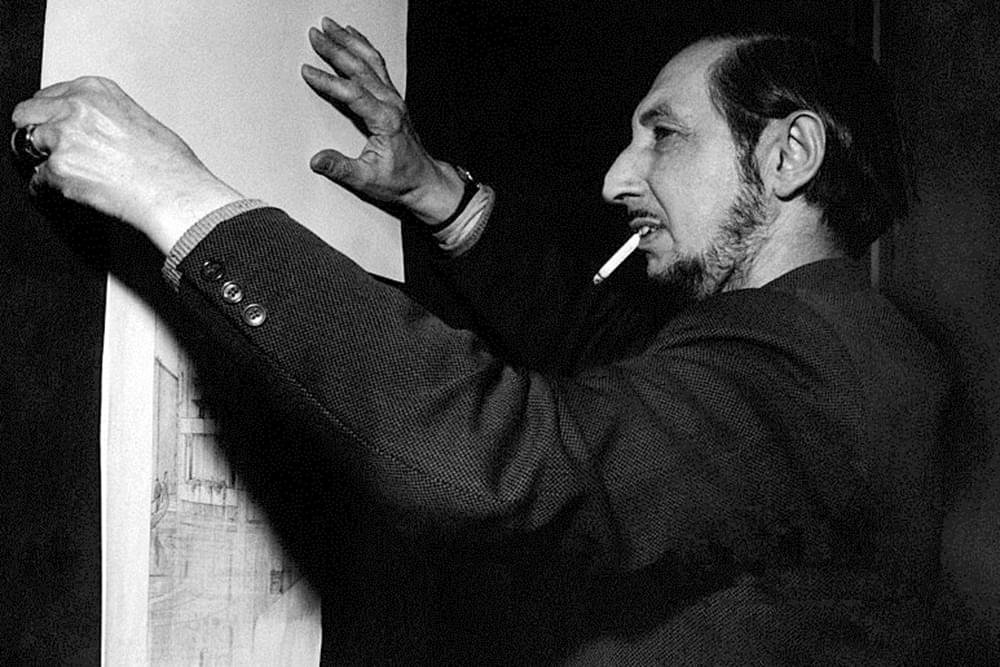
Carlo Scarpa was a prominent modernist Italian architect, artist, designer. Scarpa is best know for his architectural works, but during his professional career, tried his hand at many other artistic disciplines such as, glass work, painting and furniture design. It is the intricate characteristics of these crafts and his diverse range of his skills that are often attributed to the techniques and language of his architectural design. His architectural works have been the subject of much intellectual debate and he is considered to be one of modernism's most enigmatic yet important exponents.

Scarpa was born in Venice on June 2, 1906. His father, Antonio Scarpa was an elementary school teacher. When Scarpa was two, the family moved to Vicenza, where Carlo Scarpa attended the Technical High School. After the death of his mother in 1919, the family returned to Venice where he attended the Royal Academy of Fine Arts, focussing his studies on Architectural design. After receiving his diploma in 1926 and having apprenticed for the architect Vincent Rinaldo, Scarpa began teaching architectural drawing at the Academy. He held this position until 1929.

The 1920's and 30's were a pivotal time in Scarpa's professional life, and would shape his future work. Carlo Scarpa never completed a formal architectural degree. He was disinterested in the rigid conventions of a formal design education and its academic rules. The rejection of standardised design principles especially on how materials could or couldn't be used would characterize his work. His sensitivity to materiality and detailing were that of a master craftsman. In 1927 he began a collaboration with master glass workers on the island of Murano. Further work with Cappellini and Co., and a creative director position at Venini Glass Works where he worked from 1934 to 1947, would ignite his passion and skill with the material, as well as his desire to push it and other materials beyond their typical capabilities and use.

It was at this time he also tried his hand professionally in various capacities at industrial and interior design. Scarpa's devotion to various techniques of construction, would provide him with the palate to manipulate architectural detailing and form.

After the second world war Scarpa began to gain recognition internationally. His work became heavily influenced by the great American modernist architects such as Frank Lloyd Wright, whom Scarpa idolized.

The first important commission of this period was the renovation of the Accademia Museum in Venice, located in an old convent. This project was the first of Carlo Scarpa's museum renovations. His design was lauded for its sensitivity to the existing building. The treatment of the renovation became synonymous with Scarpa's skill at renovating historic buildings. It permitted the old and the new to exist harmoniously, yet independently.

Carlo Scarpa remained a teacher at the University of Venice throughout the early postwar period, but began to recieve commissions that would become his masterpieces.

The most important are the Canova Plaster Cast Gallery in Possagno (Treviso) (1955-1957); the Castelvecchio Museum in Verona (1956) perhaps his most significant masterpiece; the Olivetti showroom in Piazza S. Marco, Venice (1957-1958); the Querini-Stampalia Foundation in Venice (1961-1963); the Brion Tomb in San Vito d'Altivole (Treviso) (1969), was a rare example of a standalone building by Carlo Scarpa. However, it remains one of his most symbolic and important works. It represents and culminates Scarpa's career and design mantras perfectly. Quite fittingly, it is where Scarpa is now buried. He died, accidentally, in 1978, aged 72, when he fell down a flight of stairs in Sendai, Japan.

Nation Dossier

Flag of Italy

Italy

A compact nation-state reference: scale, structure, capability, and performance — designed to sit beneath articles.

Governance Economy Made in Italy Performance
Italy — national feature image
Italy at a glance — then the bigger picture: what shaped the state, how it works, what it produces, and where it stands.

Italy — global snapshot

Stable reference signals for quick orientation.

Area

301,340 km²

Covers a long peninsula extending into the Mediterranean, plus two major islands — Sicily and Sardinia — and numerous smaller island groups. The geography includes alpine regions, fertile plains, volcanic zones, and extensive coastline, shaping settlement, climate, and transport patterns.

Population

~59 million

One of the largest populations in the European Union, with density concentrated in urban and northern regions. Long-term demographic trends include low birth rates, population ageing, and increasing reliance on inward migration for workforce balance.

Coastline

~7,600 km

A predominantly maritime nation bordered by the Tyrrhenian, Adriatic, Ionian, and Ligurian seas. The extended coastline supports ports, tourism, fisheries, naval infrastructure, and a long-standing seafaring and trading tradition.

UNESCO sites

61

The highest number of UNESCO World Heritage Sites globally, spanning ancient cities, archaeological landscapes, historic centres, and cultural routes. This reflects Italy’s layered civilisations and the density of preserved cultural assets across its territory.

Currency

Euro (EUR)

Member of the Eurozone, with monetary policy set at European Central Bank level. Use of the euro facilitates trade, investment, and financial integration across the EU single market.

Time

CET / CEST

Operates on Central European Time, with daylight saving applied seasonally. The time zone aligns Italy with major European capitals, supporting coordination in business, transport, and broadcasting.

Tourism

~50–65M

Among the world’s most visited countries, attracting visitors for heritage cities, landscapes, cuisine, and lifestyle. Tourism is economically significant but regionally uneven, with strong seasonal concentration in major destinations.

Global role

G7

A founding member of the European Union and a permanent participant in G7 coordination. Italy’s influence is exercised through diplomacy, industrial capability, cultural reach, and multilateral institutions.

Governance

A layered republic

A parliamentary republic with powers and delivery spread across state, regions, and comuni — which is why outcomes can vary by territory.

Economy

Diversified, export-capable

Services dominate overall output, while manufacturing remains a defining strength through specialised clusters and global supply chains.

Made in Italy

Quality as an ecosystem

Design, craft, engineering, and brand power — often delivered by small and mid-sized firms rooted in local capability.

Performance

Strengths with constraints

World-class sectors alongside long-running challenges: uneven productivity, demographic pressure, administrative complexity, and fiscal limits.

Italy governance
Governance
Italy economy
Economy
Made in Italy
Made in Italy
Italy performance
Performance
Italy history

History

From unification to a modern republic

Modern Italy is a relatively young nation-state built from older city-states, kingdoms, and strong regional identities. Unification created the national framework, but local character remained powerful — shaping language, administration, and culture across the peninsula. The post-war republic rebuilt institutions, expanded democratic participation, and redefined the state’s relationship with citizens through welfare, education, and public infrastructure. European integration then anchored Italy within shared rules and markets, while the late 20th and 21st centuries have focused on balancing growth, reform, and cohesion in a complex, decentralised country.

Italy contribution and influence

Contribution

Europe, culture, industry

Italy’s contribution travels through EU participation, diplomacy, research networks, industrial capability, and cultural reach. In practice, influence is often most visible through specific strengths: design and heritage leadership, advanced manufacturing and specialist supply chains, food and agricultural standards, and world-class tourism and creative industries. Italy also plays a sustained role in Mediterranean and European stability through alliances, humanitarian operations, and institutional cooperation. Rather than a single narrative, Italy’s global presence is best understood as a portfolio of high-impact domains where craft, identity, and technical competence combine.