Italian politics, democratic republic, council of ministers, senate, president of the republic, Primo Ministro, Italian judiciary, Constitution of Italy
Palazzo Montecitorio, Palazzo del Quirinale, Palazzo Madama, Palazzo Chigi
Profile Menu
Italian Politics - Government
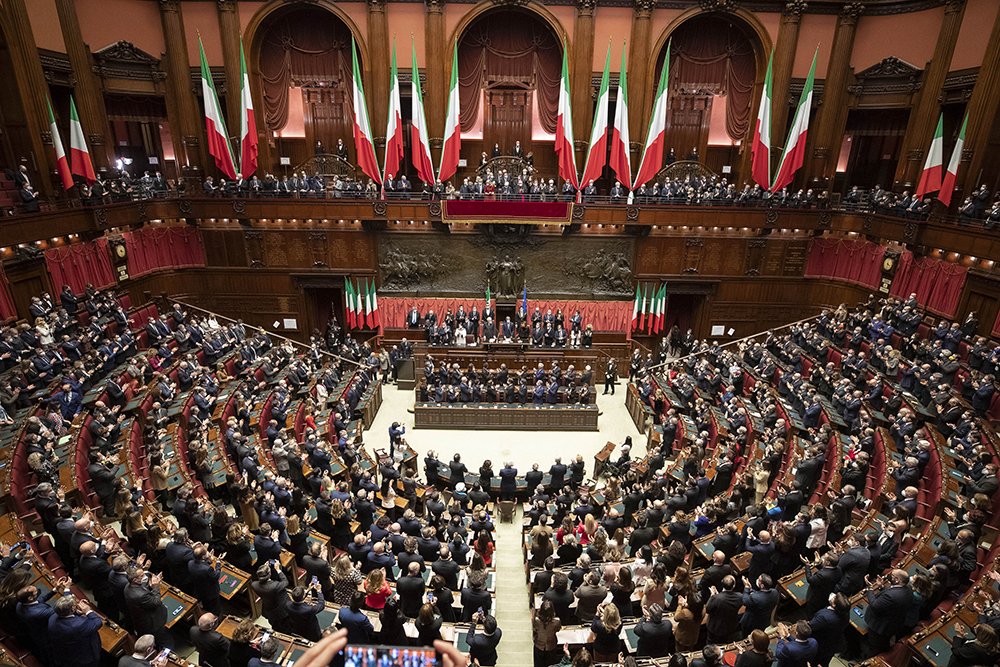
In June 1946, the Italian people voted to abolish the Monarchy and the country became a Democratic Republic. The Italian Parliament is made up of 946 elected members. There are two houses, both with equal rights and powers. The Italian Chamber of Deputies, the lower house, has 630 seats. For elections to the lower house, the country is represented by 26 constituences. These constituences elect 617 members of Parliament between them. Aosta Valley elects one more and the remaining 12 are elected by Italians living abroad.
The Italian Senate, the upper house, has 317 seats. For elections to the Senate, votes are cast regionally with 6 seats allocated to Italians living abroad. Both houses are elected every five years.
Unlike the British and American system, where votes are cast for individual candidates, the Italian voting system is based on a 'Party List' system, where each party's candidates are ranked in order of priority. If a party wins 10 seats, for example, then the first 10 candidates on their list are selected and take their seats in Parliament.
Coalitions are actively encouraged by the system. In forming a coalition to fight an election, individual parties must sign up to a coalition document and agree to support a single, nominated leader.
If a coalition wins the election with less than the 340 seats required for a working majority, then they are assigned additional seats, equivalent to a 54% majority.
The party or coalition with the largest vote is asked to form a government by the President of the Republic. This government must then receive a vote of support from both houses before it can exercise power. Thereafter, it is supported by Parliament through a series of 'votes of confidence' in the two houses. Parliament can request a new vote at any time, once a certain proportion of members wish it. If the government fails to gain enough support it must resign.
At this point the President can ask the parties to create a new government that does have the support of Parliament or he can attempt to create a new government of his own design. If either of those options fail to win support, Parliament is dissolved and new elections are held.
This electoral law has been widely criticised by the centre left parties, as they believe it favours parties from the right. Reform of the electoral laws is currently being proposed.
The Italian Senate, the upper house, has 317 seats. For elections to the Senate, votes are cast regionally with 6 seats allocated to Italians living abroad. Both houses are elected every five years.
Unlike the British and American system, where votes are cast for individual candidates, the Italian voting system is based on a 'Party List' system, where each party's candidates are ranked in order of priority. If a party wins 10 seats, for example, then the first 10 candidates on their list are selected and take their seats in Parliament.
Coalitions are actively encouraged by the system. In forming a coalition to fight an election, individual parties must sign up to a coalition document and agree to support a single, nominated leader.
If a coalition wins the election with less than the 340 seats required for a working majority, then they are assigned additional seats, equivalent to a 54% majority.
The party or coalition with the largest vote is asked to form a government by the President of the Republic. This government must then receive a vote of support from both houses before it can exercise power. Thereafter, it is supported by Parliament through a series of 'votes of confidence' in the two houses. Parliament can request a new vote at any time, once a certain proportion of members wish it. If the government fails to gain enough support it must resign.
At this point the President can ask the parties to create a new government that does have the support of Parliament or he can attempt to create a new government of his own design. If either of those options fail to win support, Parliament is dissolved and new elections are held.
This electoral law has been widely criticised by the centre left parties, as they believe it favours parties from the right. Reform of the electoral laws is currently being proposed.

Silvio Berlusconi - Prime Minister
Executive power rests with the 'Council of Ministers', or Cabinet, which is led by the Prime Minister (President of the Council of Ministers). Legislative power rests primarily with the two houses of Parliament, and secondarily with the Council of Ministers. The Judiciary is independent of Parliament.

Giorgio Napolitano
President of the Republic
The President is the head of state and is independent of all branches of government. As the head of state, the President of the Republic represents the unity of the nation and has taken over many of the duties previously undertaken by the monarchy.
The President serves as a focal point between the three branches of power: he is elected by the lawmakers, he appoints the executive, and is the President of the judiciary. The President is also the commander-in-chief of the armed forces.
The President of the Republic is elected for a seven year term by an electoral college which consists of both houses of Parliament together with 58 regional representatives. His election needs a wide majority that ensures that the elected President enjoys wide support across all political parties.
While it is not forbidden by law, no president has ever served two terms. Usually, the President tries to stay out of day to day politics, and to be an institutional guarantee for all those involved in the political process. As the guardian of the Constitution of Italy, the President can also reject openly anti-constitutional laws by refusing to sign them.
The President of the Republic appoints the Council of Ministers and its President (the Prime Minister). The Prime Minister advises the President of the Republic on the composition of the rest of the Council of Ministers (the cabinet), which comprises the ministers in charge of the various governmental departments. In practice, the President accepts Prime Minister's advice, and submits the proposed Council for a vote of confidence from both parliamentary chambers.

Giorgio Napolitano
President of the Republic
The President is the head of state and is independent of all branches of government. As the head of state, the President of the Republic represents the unity of the nation and has taken over many of the duties previously undertaken by the monarchy.
The President serves as a focal point between the three branches of power: he is elected by the lawmakers, he appoints the executive, and is the President of the judiciary. The President is also the commander-in-chief of the armed forces.
The President of the Republic is elected for a seven year term by an electoral college which consists of both houses of Parliament together with 58 regional representatives. His election needs a wide majority that ensures that the elected President enjoys wide support across all political parties.
While it is not forbidden by law, no president has ever served two terms. Usually, the President tries to stay out of day to day politics, and to be an institutional guarantee for all those involved in the political process. As the guardian of the Constitution of Italy, the President can also reject openly anti-constitutional laws by refusing to sign them.
The President of the Republic appoints the Council of Ministers and its President (the Prime Minister). The Prime Minister advises the President of the Republic on the composition of the rest of the Council of Ministers (the cabinet), which comprises the ministers in charge of the various governmental departments. In practice, the President accepts Prime Minister's advice, and submits the proposed Council for a vote of confidence from both parliamentary chambers.
Profile
Profile of Italy : History of Italy : The Italian Flag : Italian National Anthem : Italian Culture : Italian Geography : Climate of Italy : Earthquakes in Italy
Government : The First Republic : The Years of Lead : The Second Republic : Italian Media : Italian Education System : Italian Healthcare System : Cosa Nostra
Camorra : 'Ndrangheta : Sacra Corona : News - Sara Scazzi : News - Naples Rubbish : Silvio Berlusconi : Giotto : Carlo Levi : Giacomo Puccini
Snakes in Italy - Introduction : Snakes in Italy - Whip Snake : Theatre - Commedia del Arte : Italian Cinema
Regions
Regions of Italy : Abruzzo : Aosta Valley : Basilicata : Calabria : Campania : Emilia-Romagna : Friuli-Venezia Giulia : Lazio : Liguria : Lombardy : Marche
Molise : Piedmont : Puglia : Sardinia : Sicily : Trentino-Alto Adige : Tuscany : Umbria : Veneto
Places
Aeolian Islands : Amalfi Coast : Aosta : Argentario : Baroque Sicily : Bologna : Catanzaro : Chiantishire : Cinque Terre : Costa Smeralda : Florence : Garfagnana
Lauria : Lucca : Maratea : Maremma : Milan : Pompei : Porto Ercole : Porto Santo Stefano : Rome : Sapri : Trento : Tropea : Trieste : Turin : Tuscan Islands
Vatican City : Venice : Viareggio
Visiting Italy
Visiting Italy : Italian Airports : Getting Around Italy : Weddings in Italy : Golf in Italy : Sailing in Italy : Italian Tourist Websites : Useful Italian Phrases
Viareggio Carnival : Puccini Festival : Festival of Sant' Efisio : Venice Carnival
Living in Italy
Living in Italy : Choosing an area to live : Finding Property : Buying property in Italy : Living Legally in Italy : Registering for School : Registering for Healthcare
Italian Tax System : Italian Recipes - Passata : Motoring in Italy
Italian Food
Italian Food : Food of Abruzzo : Food of Aosta Valley : Food of Basilicata : Food of Calabria : Food of Campania : Food of Emilia-Romagna
Food of Friuli-Venezia Giulia : Food of Lazio : Food of Liguria : Food of Lombardy : Food of Marche : Food of Molise : Food of Piedmont : Food of Puglia
Food of Sardinia : Food of Sicily : Food of Trentino-Alto Adige : Food of Tuscany : Food of Umbria : Food of Veneto