Trento, trento italy, trento trentino alto adige, tourist information trento, visiting trento, facts about trento, information on trento
Trentino-Alto Adige Menu
Trento

Trento is the rather upmarket capital city of the northern region of Trentino Alto Adige.
Historically, Trento was a fairly rich and proud town and outside the city walls large and expensive manor houses were built to enable bishops to come and enjoy holidays. Today, Trento is still one of the nation's wealthiest and most prosperous cites with most of its wealth coming from farming, wine, and high-tech industries. Unfortunately, it is also one of the most expensive cities in Italy.
Trento is one of the major educational, scientific, financial and political centres in Northern Italy. The University of Trento ranks highly in Italy and the rest of the world, with a particularly good record in engineering.
Modern day Trento is a highly developed and organised cosmopolitan city, the centre of which is more or less a pedestrian area. The city centre is small and the architecture has a unique feel. In the picturesque Medieval and Renaissance historic centre the buildings have been restored to their original pastel colours with wooden balconies. Part of the medieval city walls are still visible and these walls once encircled the whole city and were connected to Castello del Buonconsiglio.
The main points of interest during a visit to the city are:
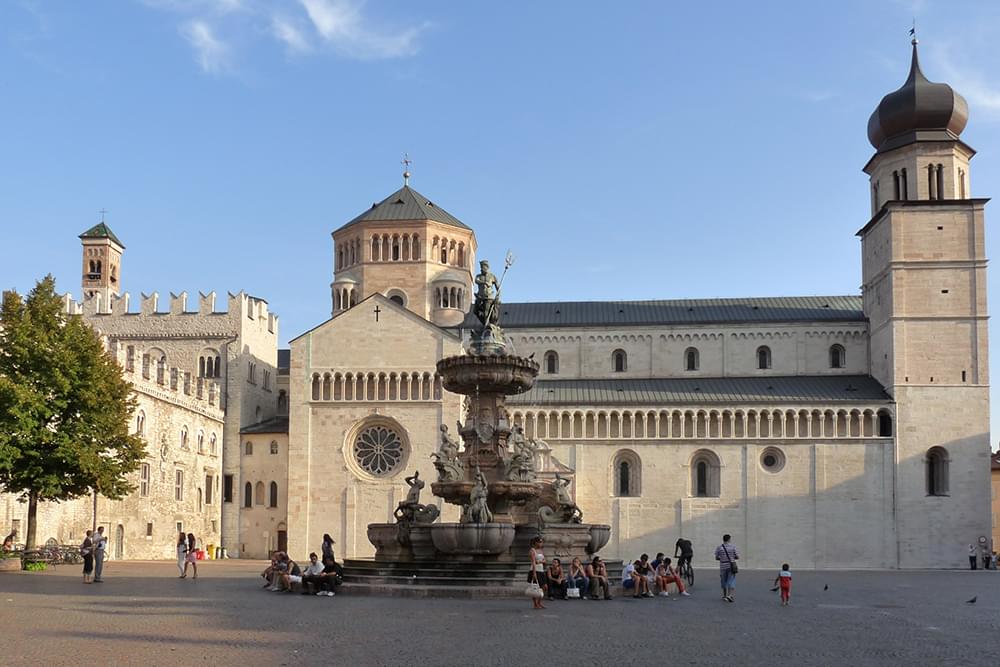
The Duomo which is a Romanesque-Gothic cathedral built on top of a Roman basilica in the late 12th century. The Roman basilica can be viewed from an underground crypt. The piazza on the side of the cathedral has many frescoed Renaissance buildings Baroque Fountain of Neptune (Fontana di Nettuno) which was built in 1767-1768.
Palazzo Pretorio, next to the Duomo and also built in the 12th century, has an interesting 13th century bell tower and is now home to a collection of baroque religious paintings. It was the main Bishops' residence until the mid-13th century.
Castello del Buonconsiglio, which includes a museum and the notable Torre dell'Aquila. You will also find here some fine Gothic frescoes which depict the months of the year.
In Via Prepositura and Piazza Cesare Battisti there are Various underground remains of the streets and villas of the Roman city.
The churches of Santa Maria Maggiore, San Pietro, Sant'Apollinare and San Lorenzo.
Palazzo delle Albere which has an excellent modern art museum and Palazzo's Salvadori, Geremia and Lodron.
Museo dell'Aeronautica Gianni Caproni which is located in Trento - Mattarello's Airport and is anotable aeronautical museum.
The surrounding countryside is famous for its beautiful mountain landscapes and at Easter the fields around Trento are filled to bursting with apple blossoms.
Historically, Trento was a fairly rich and proud town and outside the city walls large and expensive manor houses were built to enable bishops to come and enjoy holidays. Today, Trento is still one of the nation's wealthiest and most prosperous cites with most of its wealth coming from farming, wine, and high-tech industries. Unfortunately, it is also one of the most expensive cities in Italy.
Trento is one of the major educational, scientific, financial and political centres in Northern Italy. The University of Trento ranks highly in Italy and the rest of the world, with a particularly good record in engineering.
Modern day Trento is a highly developed and organised cosmopolitan city, the centre of which is more or less a pedestrian area. The city centre is small and the architecture has a unique feel. In the picturesque Medieval and Renaissance historic centre the buildings have been restored to their original pastel colours with wooden balconies. Part of the medieval city walls are still visible and these walls once encircled the whole city and were connected to Castello del Buonconsiglio.
The main points of interest during a visit to the city are:
The Duomo which is a Romanesque-Gothic cathedral built on top of a Roman basilica in the late 12th century. The Roman basilica can be viewed from an underground crypt. The piazza on the side of the cathedral has many frescoed Renaissance buildings Baroque Fountain of Neptune (Fontana di Nettuno) which was built in 1767-1768.
Palazzo Pretorio, next to the Duomo and also built in the 12th century, has an interesting 13th century bell tower and is now home to a collection of baroque religious paintings. It was the main Bishops' residence until the mid-13th century.
Castello del Buonconsiglio, which includes a museum and the notable Torre dell'Aquila. You will also find here some fine Gothic frescoes which depict the months of the year.
In Via Prepositura and Piazza Cesare Battisti there are Various underground remains of the streets and villas of the Roman city.
The churches of Santa Maria Maggiore, San Pietro, Sant'Apollinare and San Lorenzo.
Palazzo delle Albere which has an excellent modern art museum and Palazzo's Salvadori, Geremia and Lodron.
Museo dell'Aeronautica Gianni Caproni which is located in Trento - Mattarello's Airport and is anotable aeronautical museum.
The surrounding countryside is famous for its beautiful mountain landscapes and at Easter the fields around Trento are filled to bursting with apple blossoms.
Profile
Profile of Italy : History of Italy : The Italian Flag : Italian National Anthem : Italian Culture : Italian Geography : Climate of Italy : Earthquakes in Italy
Government : The First Republic : The Years of Lead : The Second Republic : Italian Media : Italian Education System : Italian Healthcare System : Cosa Nostra
Camorra : 'Ndrangheta : Sacra Corona : News - Sara Scazzi : News - Naples Rubbish : Silvio Berlusconi : Giotto : Carlo Levi : Giacomo Puccini
Snakes in Italy - Introduction : Snakes in Italy - Whip Snake : Theatre - Commedia del Arte : Italian Cinema
Regions
Regions of Italy : Abruzzo : Aosta Valley : Basilicata : Calabria : Campania : Emilia-Romagna : Friuli-Venezia Giulia : Lazio : Liguria : Lombardy : Marche
Molise : Piedmont : Puglia : Sardinia : Sicily : Trentino-Alto Adige : Tuscany : Umbria : Veneto
Places
Aeolian Islands : Amalfi Coast : Aosta : Argentario : Baroque Sicily : Bologna : Catanzaro : Chiantishire : Cinque Terre : Costa Smeralda : Florence : Garfagnana
Lauria : Lucca : Maratea : Maremma : Milan : Pompei : Porto Ercole : Porto Santo Stefano : Rome : Sapri : Trento : Tropea : Trieste : Turin : Tuscan Islands
Vatican City : Venice : Viareggio
Visiting Italy
Visiting Italy : Italian Airports : Getting Around Italy : Weddings in Italy : Golf in Italy : Sailing in Italy : Italian Tourist Websites : Useful Italian Phrases
Viareggio Carnival : Puccini Festival : Festival of Sant' Efisio : Venice Carnival
Living in Italy
Living in Italy : Choosing an area to live : Finding Property : Buying property in Italy : Living Legally in Italy : Registering for School : Registering for Healthcare
Italian Tax System : Italian Recipes - Passata : Motoring in Italy
Italian Food
Italian Food : Food of Abruzzo : Food of Aosta Valley : Food of Basilicata : Food of Calabria : Food of Campania : Food of Emilia-Romagna
Food of Friuli-Venezia Giulia : Food of Lazio : Food of Liguria : Food of Lombardy : Food of Marche : Food of Molise : Food of Piedmont : Food of Puglia
Food of Sardinia : Food of Sicily : Food of Trentino-Alto Adige : Food of Tuscany : Food of Umbria : Food of Veneto